A legal dispute at the city gate, grain drying on a rooftop, a family marking sacred time with a meal, a prophet speaking into a national crisis – this is the world of ancient israelite culture. For anyone who wants to read the Hebrew Bible with greater clarity, culture is not decorative background. It is the setting that gives force to ordinary words, sharpens the meaning of laws, and turns familiar stories into lived human experience.
Why ancient israelite culture matters for reading the Bible
Many readers first meet ancient Israel through translation. That is valuable, but translation alone can flatten a world. A word for house may mean more than a building. A gate may function as a courtroom, marketplace, and civic center. Bread, oil, vineyards, shepherding, inheritance, purity, kingship, covenant – these were not abstract ideas. They belonged to a concrete society with rhythms of labor, worship, kinship, and memory.
This is one reason the study of Biblical Hebrew is so exciting. Language carries culture inside it. Vocabulary reflects social priorities. Idioms preserve habits of thought. Even small grammatical details can signal social relationships, urgency, emotion, or legal force. When we begin to see the cultural world behind the text, passages that once seemed distant become more precise and more compelling.
The household at the center of ancient israelite culture
At the heart of ancient Israel stood the household. Modern readers often imagine identity in strongly individual terms, but the basic social unit in the Hebrew Bible is usually the family embedded in a larger kinship network. Land, labor, marriage, inheritance, and honor were deeply tied to the household.
This helps explain why genealogies matter so much. To many modern readers they feel like interruptions. In ancient Israel they established belonging, continuity, and legal standing. They located a person within a people, a territory, and a story handed down across generations.
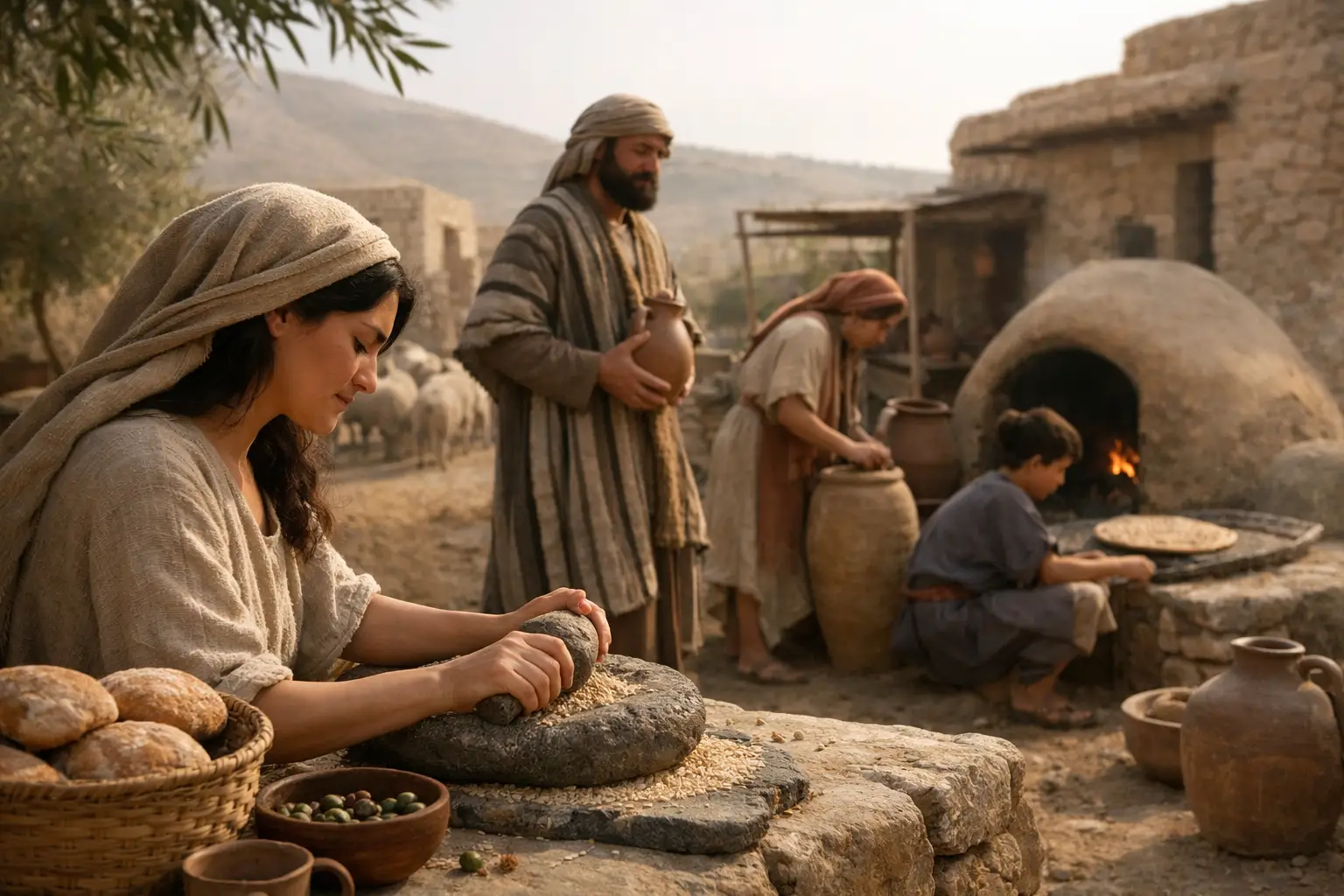
Households were also economic centers. Spinning, weaving, food preparation, storage, animal care, and child formation all happened there. The home was not sharply separated from productive work the way it often is in modern life. That means when the Hebrew Bible speaks about wisdom in the home, the capable wife, children, servants, livestock, or stored grain, it is speaking into an integrated social and economic reality.
Women’s roles in this world were substantial, though they varied by class, time period, and circumstance. The biblical texts reflect a patriarchal society, and that should be stated plainly. Yet women appear not merely as background figures, but as agents within family strategy, worship, political crises, poetry, and memory. The culture had strong structural limits, but lived reality could be more complex than a simple formula suggests.
Land, farming, and the agricultural year
Ancient Israel was shaped by land. Rainfall patterns, soil conditions, terraced hillsides, flocks, vineyards, olive groves, and grain harvests were not just economic concerns. They formed the imagination of the biblical writers.
This is why agricultural imagery fills the Hebrew Bible. Blessing is described in terms of grain, wine, and oil. Disaster appears as drought, blight, failed crops, or enemy devastation of fields. Justice and injustice are not merely spiritual categories. They affect whether families eat, whether debts can be paid, and whether ancestral land remains in the clan.
The agricultural calendar also shaped sacred time. Festivals were not floating religious observances detached from daily life. They were tied to harvest cycles and communal memory. Passover and Unleavened Bread, Weeks, and Booths connected theology to seasons, labor, and historical identity. Worship was woven into the year that farmers and shepherds actually lived.
Still, ancient Israel was not uniform. Life in the hill country differed from life in the Shephelah or the Jordan Valley. Urban centers and villages did not function identically. Some periods were more centralized politically and religiously, while others were more local and fragmented. So when we speak of Israelite farming life, we are naming a shared pattern, not a single unchanging experience.
Worship, holiness, and sacred order
One of the most distinctive features of ancient israelite culture is the way worship and daily life belong together. In modern terms, people often separate religion from politics, economy, family life, and law. Ancient Israel did not draw those boundaries in the same way.
Holiness had to do with God’s presence, but also with space, time, food, bodies, and communal order. The tabernacle and later the temple stood at the symbolic center of Israel’s life with God, yet holiness language reaches into ordinary concerns. Clean and unclean categories, priestly responsibilities, sacrifices, festivals, vows, and Sabbath observance all reveal a culture trying to order life before a holy God.
These practices can seem strange to modern readers, especially sacrificial rites. But they were not random religious gestures. They expressed gratitude, atonement, dependence, and covenant relationship. They also taught through action. Ancient worship formed memory and identity in a world where theology was embodied, repeated, and shared publicly.
At the same time, the Hebrew Bible itself contains internal critique. Prophets challenge empty ritual, exploitation, and hypocrisy. That tension matters. Ancient Israelite religion was not presented as mechanically effective. Worship divorced from justice was repeatedly condemned.
Law, justice, and life at the gate
Biblical law makes far more sense when read within ancient Israelite society. Law was not only a list of rules. It was a way of shaping a covenant people. Some laws sound universal in moral scope. Others are case laws rooted in agrarian life, property disputes, injury, debt, marriage, and boundaries.
The city gate often functioned as a place of legal process and public decision-making. Elders, witnesses, kinship obligations, and communal recognition all played important roles. Justice was local, embodied, and relational. That had strengths and weaknesses. It allowed law to function within community memory, but it could also leave vulnerable people exposed when local power structures were corrupt.
The biblical concern for the widow, the orphan, the poor, and the resident foreigner is especially striking in this setting. Those groups were socially fragile because they often lacked stable male protection, land security, or inherited status. Laws about gleaning, debt, and honest measures were not minor details. They were mechanisms of social survival.
If you read these passages only as legal abstractions, you miss their human weight. Cultural context returns urgency to the text.
Kings, prophets, and national identity
Ancient Israel was both tribal and national, local and royal, traditional and contested. The rise of kingship did not erase older clan structures overnight. It introduced new tensions – taxation, military organization, royal ideology, centralization of worship, and court politics.
That helps explain why the biblical portrayal of kingship is complex. A king could defend the people, establish order, and build national strength. A king could also become a danger to covenant life. The narratives of Saul, David, Solomon, and their successors are never just biographies. They are meditations on power, faithfulness, memory, and failure.
The prophets belong in this same cultural frame. They were not merely predictors of future events in the narrow modern sense. They were covenant prosecutors, poets, public theologians, and interpreters of national crisis. They spoke into war, idolatry, injustice, diplomatic alliances, and social decay. Their language is often difficult because it is saturated with the political and religious life of ancient Israel.
Language as a window into the culture of ancient Israel
This is where Hebrew becomes indispensable. To study the language is to enter the thought world more directly. Hebrew words often carry associations shaped by land, kinship, covenant, and worship. A single root may echo across legal texts, poetry, and narrative in ways translation cannot fully preserve.
Consider how often meaning depends on cultural assumptions. A blessing is not just a kind sentiment. Peace is not merely inner calm. Name, seed, inheritance, righteousness, and remembrance all operate within a larger social and theological world. Once you learn to hear those words in Hebrew, ancient Israel begins to feel less like a distant museum and more like an inhabited world.
That is why serious students of Scripture so often find that language study deepens not only comprehension, but affection. The text becomes denser, more vivid, and more human. At Biblical Hebrew Teacher, that wider world of text, archaeology, history, and culture is part of what makes the journey worth taking.
Ancient israelite culture is not a backdrop to the Bible. It is one of the ways the Bible speaks. Learn to notice the household, the field, the gate, the altar, the court, and the cadence of Hebrew itself, and the world of ancient Israel begins to open with remarkable clarity.