A student pauses over a familiar verse, sees a verb form shift, and suddenly the passage opens in a new way. That moment is why live biblical hebrew lessons matter. They do more than explain grammar. They give you a real teacher, real-time feedback, and a guided path into the language, literature, and world of ancient Israel.
For many learners, Biblical Hebrew begins with a longing that is hard to satisfy through books alone. You may want to read the Tanach more closely, prepare for ministry or academic work, teach your children with greater depth, or reconnect with the language that shaped a vast portion of religious and intellectual history. The problem is not lack of interest. It is that Hebrew can feel distant when it is taught as a pile of charts, rules, and vocabulary lists detached from the texts that made you care in the first place.
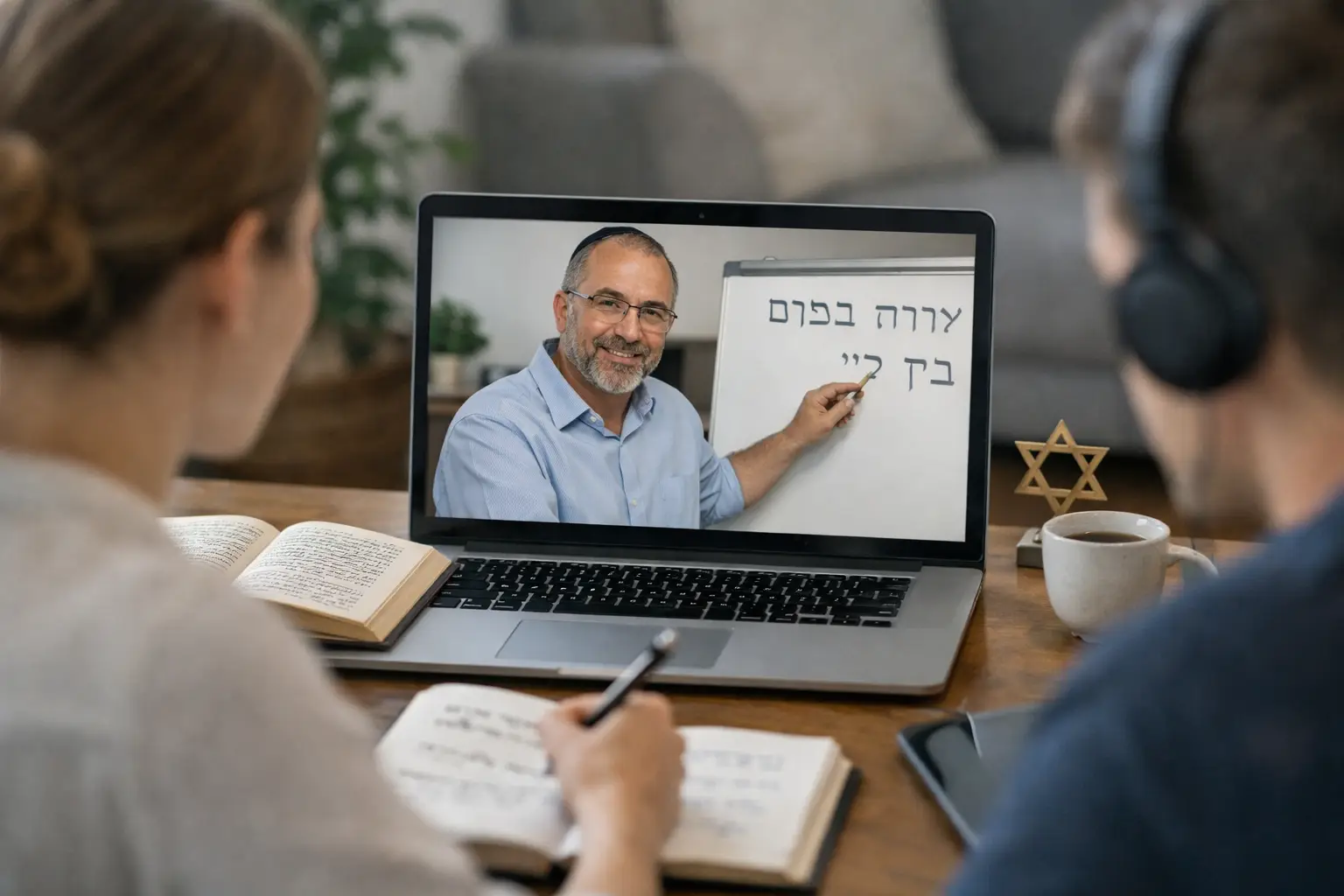
Live instruction changes that dynamic. A skilled teacher can hear how you pronounce a guttural, notice where a suffix is confusing you, and help you see why a small grammatical detail matters in context. Instead of wondering whether you understood a point correctly, you can ask at once. Instead of memorizing forms in isolation, you begin to recognize patterns in actual verses. The language stops looking like a code and starts sounding like a language with texture, history, and voice.
What makes live biblical hebrew lessons different
The chief difference is responsiveness. Recorded courses can be excellent for review, and textbooks still have their place, but neither can adjust to your pace in the moment. In a live setting, a good instructor reads the room, even if the room is online. If you grasp noun patterns quickly but struggle with weak verbs, the lesson can lean where you need it to lean. If a passage in Genesis or Psalms raises questions about syntax, culture, or translation, those questions become part of the lesson rather than distractions from it.
That flexibility matters because students do not all come for the same reason. A seminarian may need disciplined grammatical precision. A retired adult learner may want to read slowly for joy and spiritual enrichment. A homeschool family may need an approach that is structured, vivid, and memorable without becoming dry. Live teaching can meet these different aims without flattening them into a one-size-fits-all method.
There is also an energy in live study that is hard to replace. Biblical Hebrew was not written by grammar charts. It came from a real people in a real land, across centuries of history, poetry, law, worship, exile, return, kingship, and everyday life. When a teacher brings language together with archaeology, geography, historical context, and literary insight, Hebrew becomes more than a subject. It becomes a doorway into the civilization that produced the text.
Live biblical hebrew lessons and long-term retention
One of the quiet frustrations of language study is forgetting what you thought you had learned. Many students can recognize a form one week and lose it the next. This is not a sign of failure. It usually means the material has not been anchored deeply enough in sound, pattern, and repeated use.
Live lessons help retention because they combine explanation with interaction. You say forms aloud. You hear them corrected. You connect them with memorable examples. You review them in context rather than as abstract data. Strong teachers also use memory techniques that reduce overload and help students group information in sensible ways. That matters especially in Biblical Hebrew, where learners often become discouraged by the appearance of complexity before they have had time to see the system underneath it.
Still, live teaching is not magic. It works best when paired with steady practice between sessions. A weekly lesson without review can become inspiring but inefficient. On the other hand, a thoughtful rhythm of live instruction, short reading assignments, and guided repetition can produce surprising momentum. Progress in Hebrew is often less about cramming and more about consistent return.
Why context matters as much as grammar
Some students have been taught to think that serious Hebrew study must be narrowly grammatical. Grammar is essential, of course. Without it, interpretation becomes guesswork. But grammar alone is not the whole task. Words carry the weight of culture. Idioms belong to a world. Poetic forms arise from habits of thought, worship, memory, and speech.
A live teacher can help you hold these pieces together. When you encounter a term tied to sacrifice, kinship, kingship, land, or covenant, the question is not only what form the word takes. The question is also what world the word assumes. This is where interdisciplinary teaching becomes so powerful. Insights from comparative linguistics, ancient Near Eastern history, and the archaeology of Israel do not distract from the Hebrew text. They often illuminate it.
That illumination is especially valuable for readers who care about Scripture not merely as literature but as a living inheritance. Whether your interest is Jewish, Christian, academic, or a combination of these, live study can preserve a sense of reverence while sharpening intellectual honesty. It lets you ask careful questions without draining the text of wonder.
Who benefits most from this kind of study
The short answer is that many kinds of learners do. Adults returning to study after many years often appreciate the human pace of a live class. Clergy and ministry students value the ability to work through passages they actually preach or teach. Independent scholars and serious readers benefit from a setting where questions are welcomed, not rushed aside.
Families and young learners can benefit too, though the format should fit the age and goal. A child preparing for a meaningful milestone may not need the same depth as an adult pursuing sustained textual study. An event-based seminar may aim more at inspiration and cultural immersion than at full language acquisition. That is not a weakness. It simply means that good live instruction begins with the right expectation.
This is where a seasoned teacher makes a decisive difference. Not every learner needs the same amount of grammar terminology, the same speed, or the same amount of homework. The best live biblical hebrew lessons are rigorous without becoming rigid.
What to look for in a live Biblical Hebrew teacher
Credentials matter, but teaching presence matters too. A strong instructor should know the language deeply and also know how to make it teachable. Those are not identical gifts. Some scholars know much and teach little. Others know how to lead students carefully from first letters to real reading.
Look for clarity, patience, and genuine enthusiasm. You want someone who can explain morphology without making it feel mechanical, who can correct errors without discouraging you, and who can connect a lesson on prefixes or verb stems to the larger beauty of the text. Good technology helps as well, especially online, but technology should serve teaching rather than replace it.
It is also worth paying attention to method. Does the teacher rely only on translation, or do they help you internalize patterns? Do they use repetition intelligently? Do they bring in passages from the Hebrew Bible early enough that your motivation stays alive? A thoughtful program often blends live instruction with carefully chosen review materials so that each lesson continues working after the class ends.
At Biblical Hebrew Teacher, this broader vision of study is central: Hebrew is taught not as a narrow puzzle but as a living gateway into the foundational book of ancient Israel and the larger world that shaped it.
The real trade-off: convenience versus formation
Recorded courses are convenient. They let you study at odd hours and repeat lessons as needed. For many people, they are an excellent supplement. But if your goal is deep reading ability, confidence with the text, and sustained motivation, live instruction offers something more formative.
The trade-off is commitment. A live lesson asks you to show up, prepare, and be known as a student. That can feel demanding, especially for busy adults. Yet that very structure is often what makes progress possible. Language learning thrives on relationship, accountability, and encouragement.
If you have wanted to read Biblical Hebrew but have been waiting until you feel ready, the better path is often to begin with a teacher who can guide your first steps well. The language of the Hebrew Bible rewards patience, but it also rewards presence. When studied live, with care and joy, it becomes less intimidating and far more alive.
A good lesson does not merely help you parse a word. It teaches you to listen more closely to a text that has shaped faith, scholarship, and civilization for millennia.