
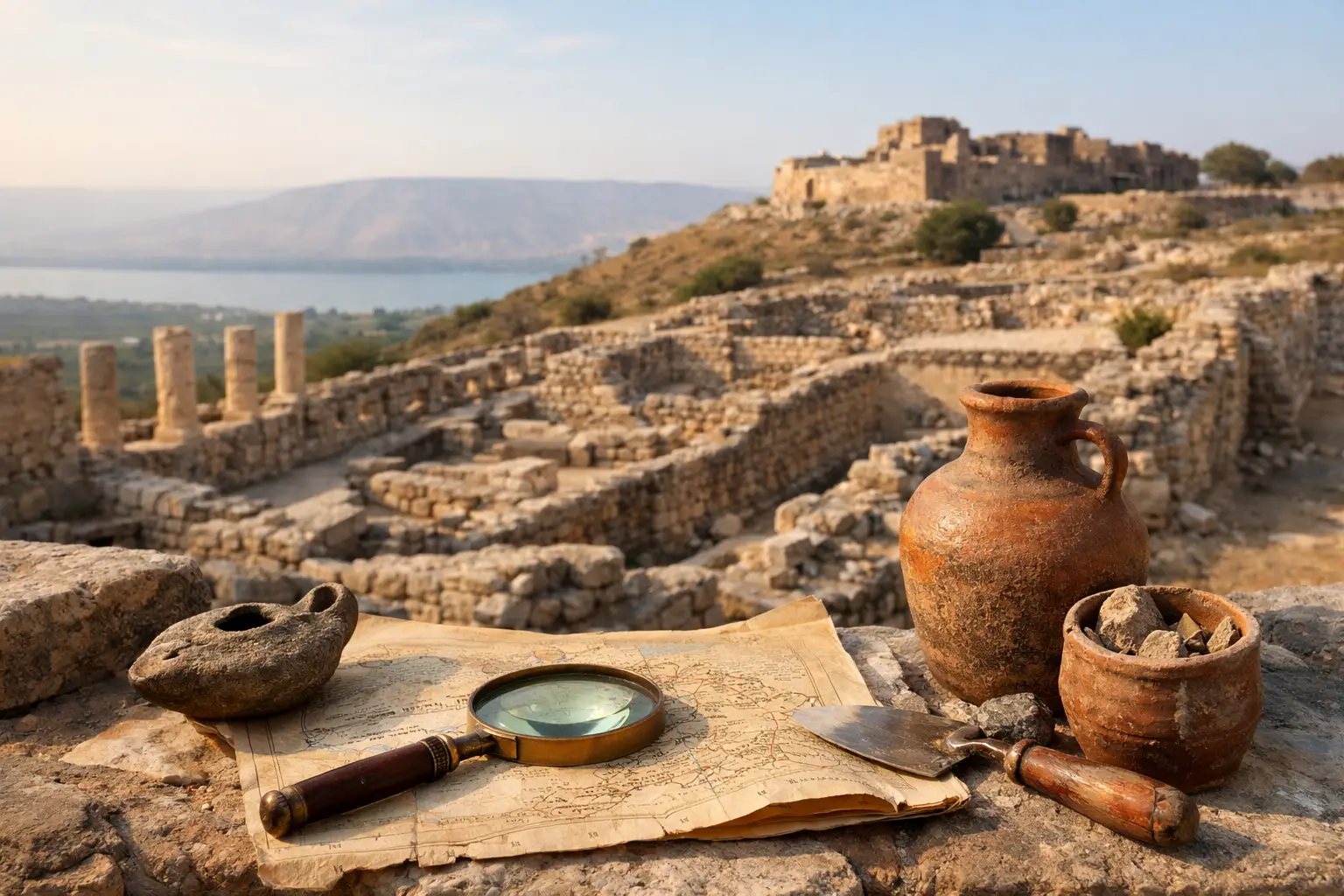
A broken pottery sherd can carry a name, a military order, a grain receipt, or a plea for help. That is part of the thrill of an ancient Israel archaeology overview: the material world of the Bible is not confined to a page. It survives in city gates, household floors, storage jars, seals, bones, inscriptions, and layers of ash beneath the soil of the Levant.
For students of Biblical Hebrew, archaeology is not a substitute for the Tanach, nor is the Tanach a simple field guide to excavations. Each speaks in a different way. Yet when they are studied together, the landscape of ancient Israel becomes more textured. Hebrew words for house, gate, altar, vineyard, king, servant, scroll, and covenant begin to belong to real places and lived experience.
What Archaeology Can and Cannot Tell Us
Archaeology studies human life through physical remains. In ancient Israel, that work includes carefully excavating settlements, recording soil layers, dating pottery, examining architecture, and interpreting objects in their original context. A jar found in a sealed destruction layer tells a different story than the same jar found loose on the surface.
This discipline is especially valuable because ancient texts rarely describe ordinary life in detail. Archaeology can show how homes were arranged, what people ate, how water was stored, how towns were defended, and how trade connected highland villages with coastal cities and neighboring kingdoms. It helps us picture the settings in which Hebrew was spoken, written, prayed, and preserved.
Its limits matter just as much. Archaeology seldom proves a biblical event in the modern courtroom sense. Many people, especially non-royal people, left no named record. Dates can be debated, destruction may have several possible causes, and an object’s meaning depends on context. The best archaeological interpretation is patient: it distinguishes what the evidence demonstrates, what it strongly suggests, and what remains possible but uncertain.
The Land of Ancient Israel Was Not One Uniform Place
The biblical land contains sharply different environments within a relatively small area. The coastal plain opened toward Mediterranean trade. The central hill country supported farming communities and defensible settlements. The Jezreel Valley was a fertile corridor contested by larger powers. The Jordan Valley and Negev demanded different patterns of travel, agriculture, and water management.
These landscapes shaped history. A city such as Megiddo stood near strategic routes through the Jezreel Valley, while Jerusalem developed in the hill country around vital water sources and steep ridges. Beersheba served the southern frontier, and sites such as Hazor and Gezer held importance because of their locations, resources, and connections.
When reading Hebrew narrative, geography often explains what a translation alone cannot. The repeated movement “up” to Jerusalem is not merely ceremonial language. Jerusalem is physically elevated. Words connected with wilderness, hill country, valley, gate, field, and spring carry geographical force. Archaeology places those words back into the terrain that gave them meaning.
Major Periods in an Ancient Israel Archaeology Overview
The broad sequence of periods is more useful than memorizing every excavation date. Chronology is debated in certain details, but the larger historical framework gives readers a reliable map.
Before Israel: Canaanite Cities and Cultures
During the Middle and Late Bronze Ages, roughly 2000-1200 BCE, the land included fortified Canaanite city-states. Excavations reveal substantial urban centers, administrative systems, imported goods, temples, and diplomatic connections with Egypt and the wider eastern Mediterranean.
This setting matters for the Hebrew Bible. Israel emerged in a land with an established population, languages, religious practices, trade routes, and political structures. Hebrew itself belongs to the Northwest Semitic family, closely related to the languages spoken by Israel’s neighbors. The Bible’s cultural world was distinctive, but it was never isolated.
The Iron Age: Israel and Judah
The Iron Age, especially from about 1200 to 586 BCE, is central to the study of ancient Israel and Judah. Archaeologists see growth in highland settlements during the earlier part of this period, followed by the rise of more complex kingdoms, fortified cities, administrative centers, and expanding literacy.
Material remains point to regional variation rather than a single identical culture. Israel, the northern kingdom, was generally wealthier and more urbanized, with sites such as Samaria, Megiddo, and Jezreel. Judah, centered on Jerusalem, developed on a different scale and trajectory. Both kingdoms participated in the political pressures of the ancient Near East.
The destruction of the northern kingdom by Assyria in 722 BCE and the Babylonian destruction of Jerusalem in 586 BCE are not only dates in a textbook. Archaeological layers, damaged buildings, weaponry, and shifts in settlement patterns bear witness to the human consequences of imperial conquest.
Persian, Hellenistic, and Roman Eras
The return from Babylonian exile and the centuries that followed are also archaeological periods. Persian-period Yehud was smaller and less populous than the kingdom of Judah had been, but it became a crucial setting for the development of Jewish communal life and Scripture. Later Hellenistic and Roman remains illuminate the world that formed the background of the Second Temple period.
For Bible students, this longer view is essential. The land’s history did not stop with the fall of Jerusalem. Hebrew, Aramaic, Greek, changing empires, pilgrimage, priesthood, and local village life all shaped the centuries in which biblical texts were copied, interpreted, and treasured.
Inscriptions: Where Hebrew Speaks from the Ground
Inscriptions are among the most moving discoveries because they preserve ancient words in ancient scripts. They also require care. A short inscription may be difficult to read, damaged, or open to more than one interpretation. Still, even a few letters can reveal much about writing, administration, names, and language.
The Siloam Inscription, associated with the water tunnel in Jerusalem, commemorates the meeting of two teams excavating through rock. The text offers a rare voice from the world of Judah. The Lachish Letters, written on pottery sherds shortly before Babylon’s conquest, preserve urgent military correspondence from a kingdom under threat. At Arad, ostraca record supplies, personnel, and official instructions in a frontier setting.
These texts are especially exciting for Hebrew learners. Biblical Hebrew is not merely a literary language encountered in printed type. Ancient Hebrew scribes wrote with ink on clay, stone, and other perishable materials. Letter forms changed over time, spelling was not always standardized, and everyday documents used phrases that can illuminate the wider linguistic environment of the Bible.
Homes, Food, Worship, and Work
Grand palaces attract attention, but ordinary houses often teach more about daily life. The so-called four-room house, common at many Iron Age sites, typically organized family life around a central space with adjoining rooms. These were working households, not private modern residences. Food preparation, storage, animal care, textile production, and family life could occur within the same small complex.
Storage jars, grinding stones, loom weights, ovens, and animal bones reveal routines behind biblical vocabulary. Grain had to be ground. Olive oil and wine required labor, presses, vessels, and distribution. Water had to be carried or gathered. These realities deepen passages about harvest, famine, hospitality, debt, gleaning, and household management.
Religion is a more complex area. Archaeologists uncover altars, figurines, standing stones, inscriptions, and cultic spaces, but objects do not always identify the beliefs of their users with precision. The Hebrew Bible itself portrays ongoing tension between devotion to the God of Israel and other religious practices. Archaeology does not erase that tension. In many cases, it makes the Bible’s prophetic protests and covenantal calls easier to understand as words addressed to a real and contested religious world.
Reading the Bible and the Spade Together
The wisest approach resists two opposite errors. One is to treat every excavated wall as an automatic confirmation of a specific verse. The other is to assume that because archaeology cannot verify every detail, biblical texts have no historical value. Ancient texts and material remains are different forms of evidence, and both must be read with skill.
Questions of chronology illustrate this well. Scholars may agree on a site’s broad Iron Age date yet disagree about whether a particular gate, palace, or destruction layer should be connected with a biblical ruler or event. Such debates are not a failure of archaeology. They are the normal work of careful historical inquiry, where pottery sequences, radiocarbon dates, inscriptions, architecture, and textual sources must be weighed together.
For the student of Biblical Hebrew, the reward is more than accumulating facts. Archaeology trains the imagination to be responsible. When you read about a city gate, you can picture a place of trade, judgment, proclamation, and public assembly. When you encounter a seal, a jar, or a letter, you can recognize the administrative and personal worlds behind the text.
The next time a Hebrew word seems distant or abstract, ask what kind of object, place, action, or landscape it may have named. That question can turn language study into a living encounter with the people who spoke, wrote, struggled, worshiped, and hoped in ancient Israel.