
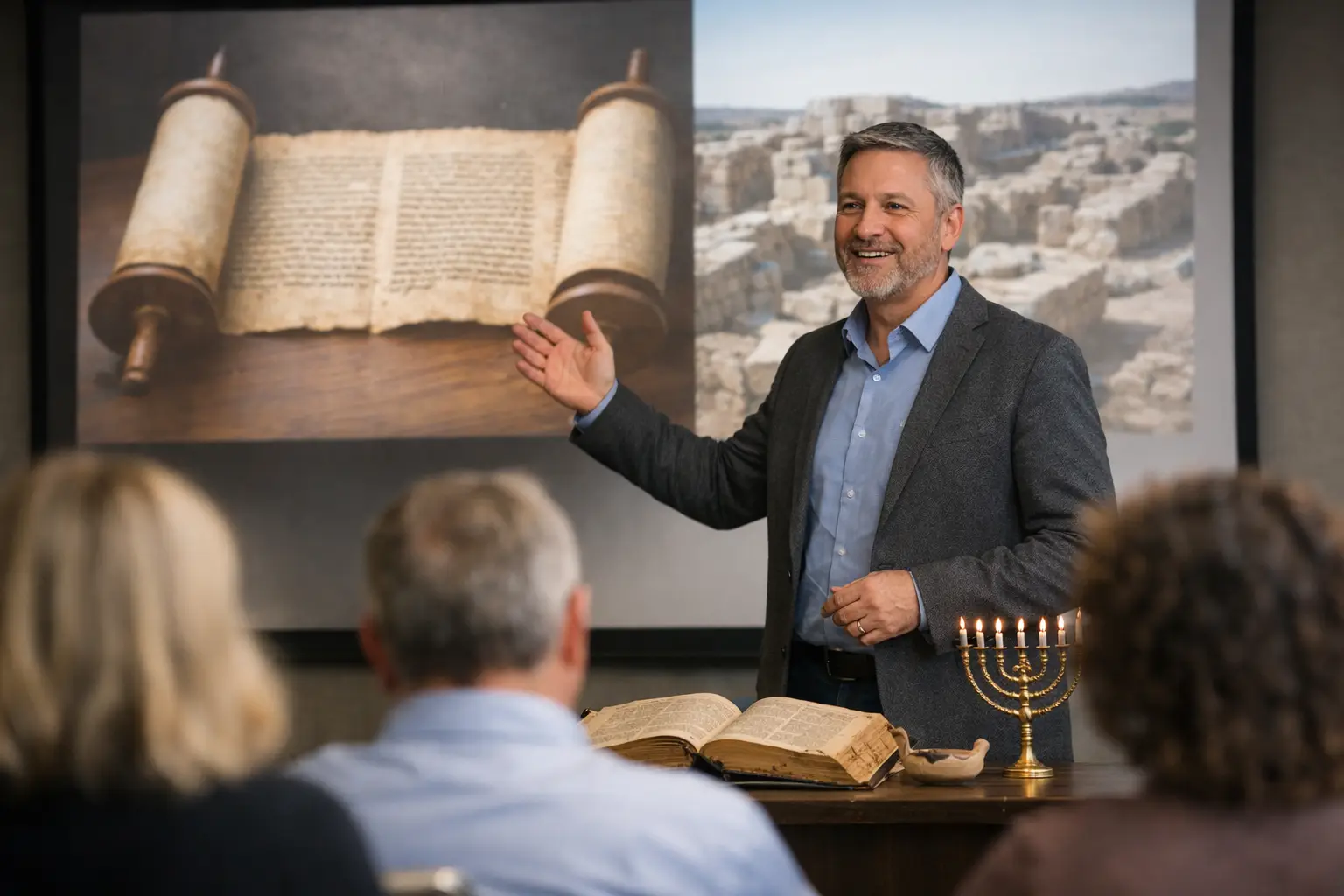
The moment a familiar biblical word is heard in Hebrew, something changes. A verse that has long seemed settled on the page becomes textured, audible, and alive with questions. A biblical hebrew seminar speaker helps create that moment for an entire room, inviting learners to encounter the language of the Tanach not as an academic obstacle, but as a doorway into the world of ancient Israel.
For a retreat, congregation, classroom, homeschool gathering, academic conference, or family celebration, the right seminar can do more than introduce a few Hebrew letters. It can give participants a lasting sense that the biblical text has a history, a landscape, a rhythm, and a voice. The best events hold serious learning and genuine delight together.
What a Biblical Hebrew Seminar Speaker Should Offer
A seminar speaker is not simply a lecturer who happens to know Hebrew. The work calls for a teacher who can read the room, honor different levels of experience, and make the language approachable without making it shallow. Some participants may know the alphabet; others may have spent years with biblical commentaries; still others may be encountering Hebrew for the first time. All should leave with something real in hand.
That begins with teaching Hebrew as a language rather than as a code to be cracked. Grammar matters deeply. Verb forms, roots, prefixes, suffixes, and syntax give careful readers the tools to see how a sentence works. Yet grammar taught in isolation can quickly become a parade of terms that few people remember. A memorable seminar connects these features to actual passages and to the people who first spoke, heard, preserved, and interpreted them.
Consider the Hebrew word shalom. It is often translated as “peace,” but its verbal root carries associations of wholeness, completion, and well-being. That does not mean every occurrence should be replaced with a long string of English alternatives. It does mean that a speaker can help participants see why “peace” in the biblical imagination reaches beyond the absence of conflict. One word can open a discussion of covenant, community, worship, and daily life.
This is the distinctive joy of a well-designed Hebrew seminar: participants learn enough to ask better questions, while gaining respect for the care that translation and interpretation require.
Begin With the Event’s Purpose
The most meaningful seminar is shaped by why people are gathering. A weekend retreat may invite a spacious exploration of prayer, Psalms, or the language of creation. A clergy gathering may benefit from close attention to a passage that regularly appears in preaching. A homeschool group may need lively, visual instruction that helps students remember letters and recognize patterns. A Bar or Bat Mitzvah celebration can become especially meaningful when family and friends explore a word, verse, or name connected to the young person’s Torah portion.
Purpose also determines pace. A single ninety-minute presentation cannot provide the same depth as a full-day workshop, and a multi-session study retreat can build skills that a keynote cannot. There is no need to pretend otherwise. A strong biblical Hebrew seminar speaker will be clear about what participants can reasonably learn in the available time, then shape the experience around one central question rather than attempting to cover the whole language.
For example, an event centered on the Shema might examine the sound and force of key words, the literary shape of the passage, and its place in Israel’s life of devotion. A seminar on Genesis 1 might trace repeated words and phrases, consider the ancient Near Eastern setting, and show how Hebrew verbs guide the movement of the account. Both sessions can be accessible to beginners. Both can also reward experienced students when the teaching is precise.
The Best Seminars Put Text, Culture, and History in Conversation
Biblical Hebrew was spoken and written in a particular land among real communities facing harvests, wars, worship, exile, family life, and political change. The language bears the marks of that world. When a speaker brings archaeology, geography, comparative linguistics, and ancient inscriptions into the room with care, the text becomes more fully situated without becoming less sacred.
Context must serve the passage, not distract from it. A photograph of an inscription, a map of Judean hill country, or a discussion of an ancient agricultural practice can illuminate a Hebrew term in a way that a dictionary entry cannot. But a seminar should not become a collection of trivia. The question is always: What does this detail help us notice in the text?
This approach is especially valuable for learners who have heard Scripture for years in English. English translations are indispensable gifts, and no responsible teacher treats a single Hebrew observation as a license to dismiss them. Hebrew study is not a hunt for hidden meanings that everyone else missed. Rather, it is a discipline of closer listening. It reveals ranges of meaning, literary wordplay, patterns of repetition, and choices that translators must weigh carefully.
That distinction protects both intellectual honesty and the wonder of discovery. Participants can come away amazed by the richness of a word without being told that one new observation overturns centuries of faithful reading.
Learning That Stays With Participants
An event is successful when participants remember more than a favorite fact. They should be able to recognize a few letters, recall a root or phrase, notice a repeated biblical word, or return to a passage with greater confidence. Memory techniques matter because Hebrew can initially feel unfamiliar to English speakers, especially when they encounter a new alphabet and read from right to left.
A gifted teacher uses sound, visual association, repetition, and participation to make learning durable. Rather than merely displaying the word אָדָם (adam) on a screen and defining it, the speaker may invite the group to say it, see its relation to אֲדָמָה (adamah, ground), and observe how the connection serves a particular passage. The learning becomes embodied and contextual at once.
Live teaching also creates room for questions. Why does a translation choose one English word over another? Is this similarity between two Hebrew terms actually meaningful, or only coincidental? How much can a beginner responsibly infer from a root? These are excellent questions. A thoughtful speaker welcomes them and explains where certainty ends. That humility is part of rigorous study.
Choosing the Right Seminar Format
Event organizers should look for a speaker who will collaborate before arriving. A brief planning conversation can clarify the audience’s background, religious setting, age range, schedule, technology, and hoped-for outcome. It also helps determine whether the session should be text-centered, language-centered, or designed as a broader introduction to the culture of ancient Israel.
For a large audience, a presentation with projected Hebrew, call-and-response pronunciation, and a focused passage can create shared energy. For smaller groups, a workshop format allows more practice, discussion, and individual questions. Online seminars can work beautifully as well when participants can clearly see the Hebrew text, hear pronunciation, and interact in real time. Advanced classroom technology is useful, but it should support human teaching rather than replace it.
At Biblical Hebrew Teacher, custom seminar experiences are built around this wider vision of Hebrew study. The aim is not merely to present vocabulary, but to share a love for the language and culture of ancient Israel while giving learners practical tools they can use after the event.
A Seminar Can Be a Beginning
The finest Hebrew events do not leave participants feeling that they have completed something. They leave them eager to keep reading. A well-chosen verse may become a companion for weeks. A newly recognized letter may make the next encounter with a Hebrew Bible feel less distant. A question raised in conversation may lead someone into regular study, deeper prayer, more careful teaching, or renewed appreciation for the foundational book of ancient Israel and the entire Western world.
That is why choosing a biblical Hebrew seminar speaker deserves attention. Look for scholarly depth, certainly, but also for warmth, clarity, and an evident love of teaching. The language has traveled across millennia to reach us. Given patient guidance and an open text, a room full of learners can begin to hear it with fresh ears.