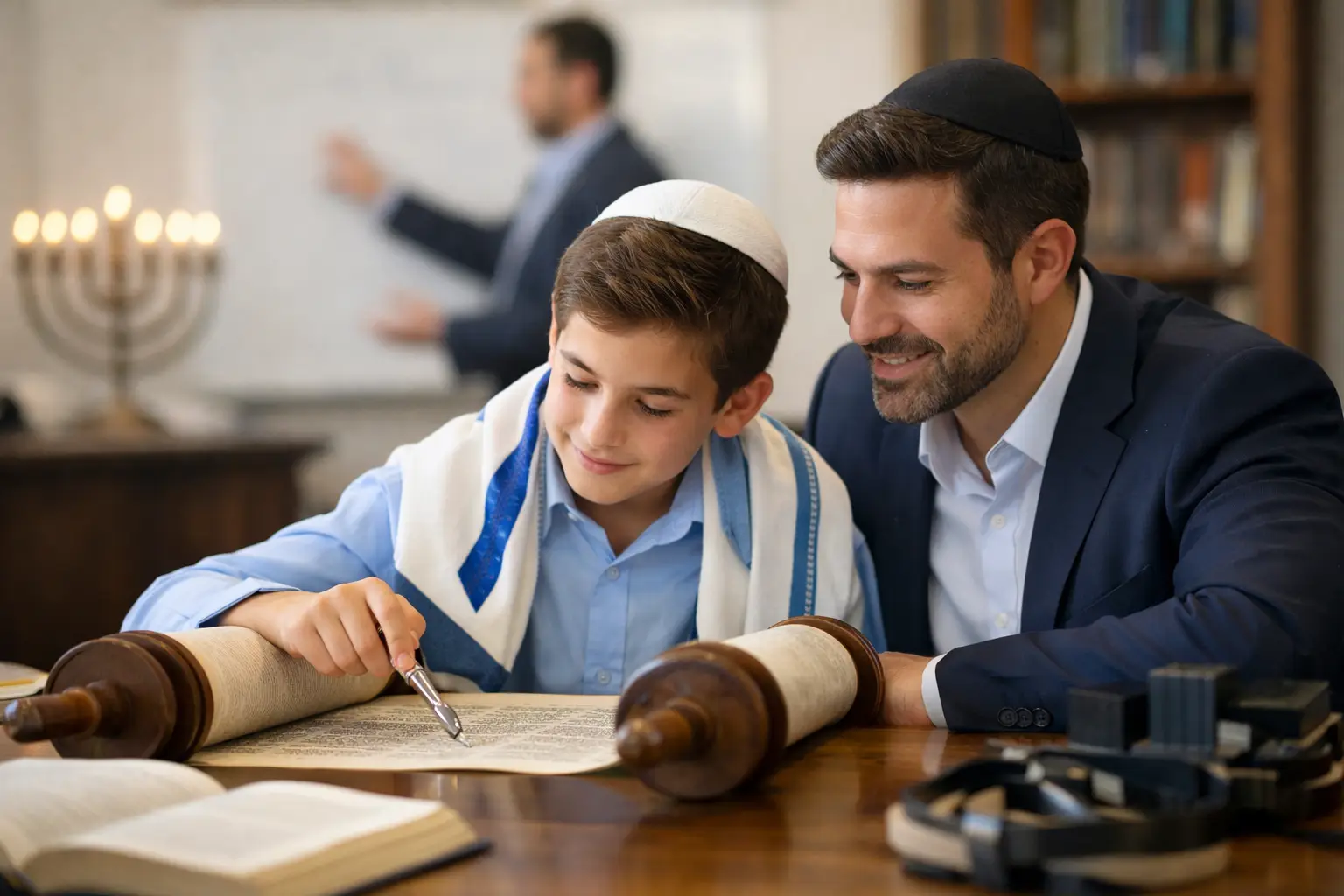
The weeks before a Bar Mitzvah can move quickly: Hebrew practice, Torah portions, family travel, speeches, invitations, and the joyful pressure of a major celebration. A bar mitzvah hebrew seminar creates a different kind of space within that season – one in which the young person and the people who love them can pause over the language itself. Rather than treating Hebrew as a string of sounds to memorize for one morning, the seminar invites a family to encounter it as the language of the Tanach, ancient Israel, and a living cultural inheritance.
For many families, that shift is profound. A blessing becomes more than a recitation. A Torah verse becomes more than an assigned passage. Hebrew begins to reveal patterns, images, wordplays, and ways of thinking that English can suggest but cannot always fully carry.
Why a Bar Mitzvah Hebrew Seminar Matters
A Bar Mitzvah marks responsibility, belonging, learning, and continuity. The ceremony is public, but its meaning is deeply personal. Hebrew study can give a young person a stronger sense of what they are stepping into: a conversation across generations, rooted in the foundational book of ancient Israel and the wider Western world.
This does not mean that every seminar must become a demanding grammar course. In fact, the most meaningful experience often begins with a few carefully chosen discoveries. A student may learn why the word bar means “son,” how Hebrew roots build families of related words, or what is happening beneath the familiar English translation of a Torah passage. Those discoveries help connect the day’s ritual language with real thought, history, and feeling.
The family benefits as well. Parents, grandparents, siblings, and friends are often present for a celebration without having had much opportunity to explore the Hebrew at its center. A seminar gives everyone shared reference points. It can turn a reception-table conversation from “He did a beautiful job” into “Did you notice what that Hebrew word actually means?”
What Happens in a Bar Mitzvah Hebrew Seminar?
The strongest seminars are built around the student, the family, and the specific occasion. A session may center on the young person’s Torah portion, favorite biblical story, Hebrew name, or a theme such as courage, justice, wisdom, hospitality, or covenant. The goal is not to overwhelm participants with terminology. It is to open a doorway.
A skilled teacher can begin with the Hebrew alphabet and its ancient development, then show how Hebrew words are formed from roots. From there, participants might examine several words from the Torah portion, sound them aloud, notice repeated letters, and compare the range of meanings they carry in different biblical contexts. Suddenly, the text becomes less distant. It belongs to a real landscape, a real people, and a language with remarkable internal coherence.
For example, a seminar built around a passage from Genesis might explore how names, place words, and repeated verbs guide the story. A seminar focused on the Prophets might consider the force of a Hebrew command or the poetic balance of a line. When appropriate, archaeology, inscriptions, geography, and comparative linguistics can add further texture. Ancient Israel was not an abstraction. It was a world of hills, cities, harvests, family life, political struggle, worship, and memory.
Learning that participants can remember
A memorable seminar does not depend on handing out a dense worksheet. Live teaching, visual patterns, spoken repetition, and well-tested memory techniques can help learners retain far more than they expect. Participants may leave able to recognize several Hebrew letters, identify a root, pronounce a meaningful word, or explain one insight from the Torah portion to someone else.
That matters because confidence changes the experience of learning. A young person who has spent months preparing a reading phonetically may discover that Hebrew is not an impenetrable code. It has patterns. It has logic. It rewards curiosity.
Choosing the Right Scope for Your Family
There is no single correct format for a Bar Mitzvah seminar. Some families want a focused 60- to 90-minute gathering during a weekend celebration. Others prefer a longer workshop for relatives, a homeschool group, a synagogue class, or a study retreat. A family may also choose a series of sessions in the months before the ceremony, giving the student time to build a more substantial foundation.
The right scope depends on several practical questions. How familiar is the student with Hebrew reading? Will guests range from young children to serious adult learners? Is the priority to illuminate the Torah portion, introduce Biblical Hebrew, or create an engaging intergenerational activity? A seminar for a mixed-age group should usually favor participation and storytelling over technical detail. A smaller group of motivated students can move further into grammar, vocabulary, and textual observation.
It also helps to be realistic about what one session can accomplish. A single seminar can kindle enthusiasm and offer lasting insights, but it cannot replace ongoing language study for someone who wants to read the Tanach independently. That is not a weakness. A well-designed introduction can be the beginning of an exciting journey, especially when it leaves participants eager to keep asking questions.
From Torah Portion to Ancient Israel
The finest Hebrew teaching does not isolate words from the world that produced them. When learners encounter a biblical term, they should also be invited to ask: What did this word mean to an Israelite farmer, judge, poet, priest, child, or traveler? What images would it have brought to mind? How does its setting in the land of Israel shape the passage?
Consider the Hebrew word shalom. It is often translated as “peace,” but its biblical range reaches toward wholeness, well-being, safety, and restoration. Learning one word with care can become a lesson in translation itself. English is valuable, but it sometimes gives us one doorway where Hebrew offers a whole courtyard.
Or consider the importance of roots. Many Hebrew words arise from three-consonant patterns, creating relationships that reward careful attention. Once students begin to recognize these patterns, they can see that biblical Hebrew is not merely a list of vocabulary items. It is an interconnected system. That realization is both intellectually satisfying and spiritually rich.
A seminar can also honor the young person’s own voice. Rather than telling a student what their Torah portion must mean to them, a teacher can guide them toward close observation. Which word surprises you? Which image feels vivid? What question would you ask an ancient listener? The answers may not be simple, but serious engagement with sacred text rarely is.
Making the Experience Welcoming
Families sometimes worry that a Hebrew seminar will be intimidating for guests who have little or no background. The opposite can be true when the teaching is generous, clear, and lively. No one needs to arrive knowing the alphabet. The teacher’s task is to make the room feel that every honest question is welcome.
Pronunciation should serve understanding, not become a test of belonging. Technical terms should be explained in ordinary language. Jewish and Christian participants, experienced readers and complete beginners, children and adults can all find a place in a thoughtfully planned session. What unites them is not identical preparation, but shared curiosity about the text and culture of ancient Israel.
For the Bar Mitzvah student, this can be especially affirming. Instead of being the only person expected to perform Hebrew, they become part of a learning community. Their preparation becomes a gift that draws others closer to the Torah and to one another.
A Celebration That Keeps Teaching
The most enduring Bar Mitzvah celebrations do not end when the last guest leaves. They give a young person something to carry forward: a question worth pursuing, a text worth revisiting, a language worth learning more deeply. A seminar can create that kind of beginning.
Whether it takes place in a living room, synagogue classroom, retreat setting, or online gathering, the best setting is one where Hebrew is treated with both seriousness and joy. At Biblical Hebrew Teacher, that means approaching the language not as a hurdle before the ceremony, but as a living gateway into the words, landscapes, history, and enduring imagination of ancient Israel.
A Bar Mitzvah arrives on a date, but learning has no need to stop there. Let the Hebrew heard on that day become an invitation to listen more closely for years to come.