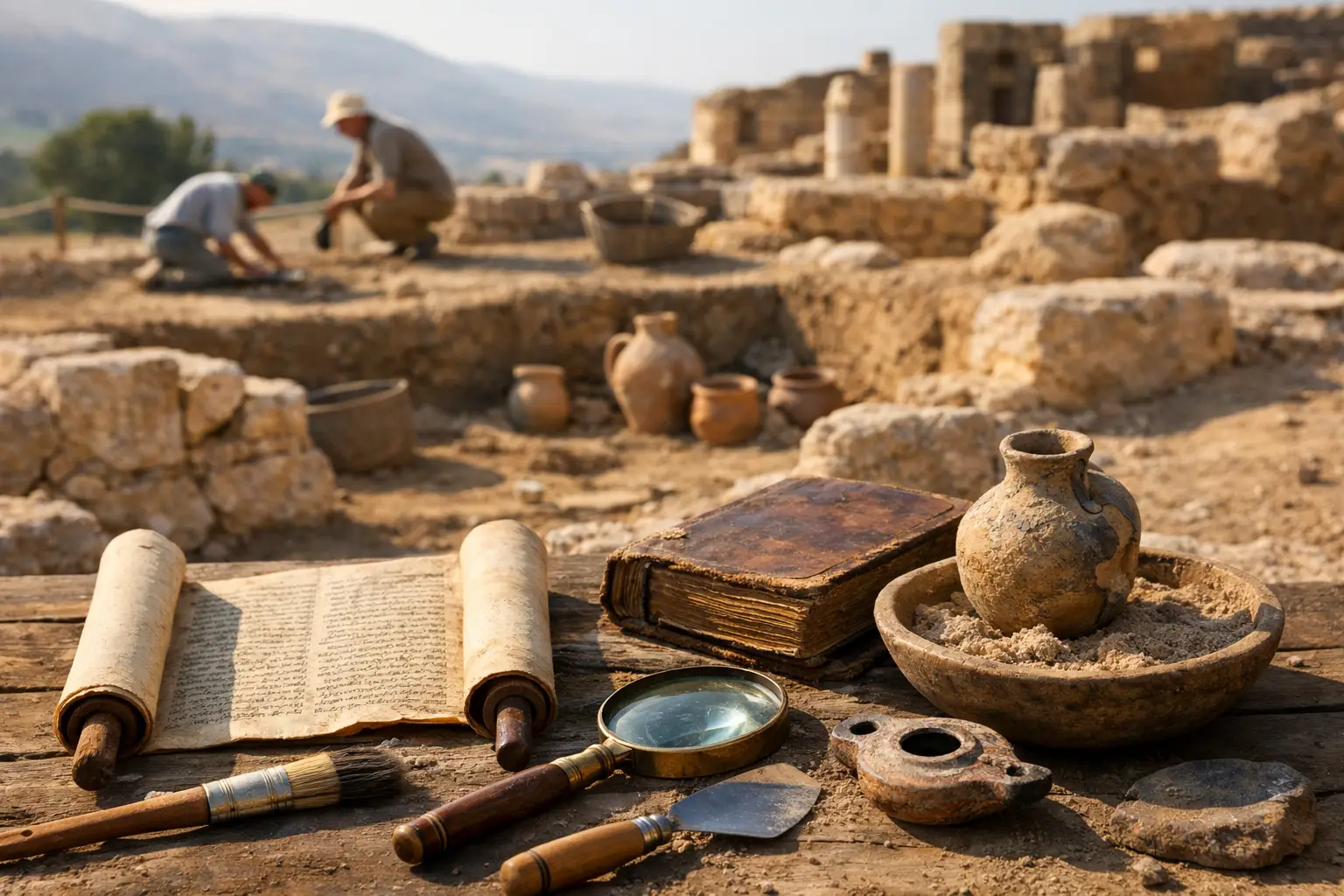
Stand in front of a pottery shard from ancient Judah, and one thing becomes clear very quickly: archaeology is not treasure hunting with Bible verses attached. It is the slow, disciplined work of recovering fragments of human life – homes, inscriptions, storage jars, city walls, cooking fires, graves, and ruined temples – and asking what they can honestly tell us. For anyone interested in biblical archaeology for beginners, that is the right place to start: not with sensational claims, but with patient attention to the world in which the Hebrew Bible emerged.
That posture matters because many newcomers arrive with two opposite expectations. Some hope archaeology will prove every biblical event exactly as written. Others assume it exists mainly to discredit the Bible. In practice, serious archaeology does neither. It studies material remains, dates them as carefully as possible, and places them in historical context. Sometimes the results illuminate a biblical passage in striking ways. Sometimes they complicate long-held assumptions. Often they simply help us see ancient Israel more clearly as a real society with language, politics, agriculture, warfare, worship, and memory.
What biblical archaeology for beginners actually studies
Biblical archaeology focuses on the lands, cultures, and periods connected to the world of the Bible, especially ancient Israel and its neighbors. That includes Canaanites, Egyptians, Philistines, Assyrians, Babylonians, Persians, and others who appear in the biblical record or shaped its setting. The field asks historical questions through physical evidence: What kind of houses did people live in? How were cities fortified? What goods were traded? What religious practices can be detected? Which languages were written and where?
Notice what is not in that definition. Archaeology does not excavate doctrines, miracles, or theological meaning in the same way it excavates a gate complex or seal impression. Material culture can illuminate the background of a text, but it does not replace the text. For readers of the Tanach, that distinction is healthy. It keeps us from asking archaeology to do a job it cannot do, while allowing it to do the work it does remarkably well.
Why archaeology matters for reading the Bible
If you care about Scripture, archaeology can train your imagination. It rescues the biblical world from becoming abstract. A command about city gates sounds different when you understand the gate area as a place of trade, judgment, and public life. A prophetic denunciation of luxury sharpens when excavations reveal ivory inlays, imported goods, and elite architecture. A psalm about shepherding, vineyards, towers, and threshing floors belongs to a landscape that archaeology helps recover.
This is one reason language study and archaeology belong together. Hebrew words arose inside a real culture. Terms for weights, agricultural tools, kinship structures, warfare, ritual objects, and administrative offices are easier to grasp when you can picture the life behind them. The more you understand ancient Israel as a lived world, the less the Bible feels like a flattened collection of quotations and the more it reads as the foundational book of ancient Israel and the entire Western world.
How archaeologists know what they know
Beginners often imagine archaeologists finding an object and immediately knowing its story. Usually the process is slower and more modest. The most basic principle is context. A jar found in a sealed destruction layer tells us more than a beautiful object purchased on the antiquities market with no record of where it came from. Context helps determine date, function, and relationship to other finds.
Stratigraphy is another key idea. Ancient sites were often built, destroyed, rebuilt, and reused over centuries. Those layers matter. A wall from one period may sit above a floor from another. Reading those layers carefully is one of the central skills of excavation.
Dating methods vary. Pottery typology is one of the most important because pottery styles change over time and are found everywhere. In some cases, radiocarbon dating helps. Inscriptions can also anchor chronology if they mention known rulers or fit a clear script style. None of these methods is magic. They work best together, and there is often debate at the margins.
That last point is worth emphasizing. Archaeology is full of interpretation. Scholars may agree on what was found but disagree on what it means. Was a structure a palace, a storehouse, or a fortress? Does an inscription refer to a specific king or dynasty? Is a destruction layer tied to one invasion or another? Beginners should not be discouraged by debate. Thoughtful disagreement is part of the field’s intellectual honesty.
A few discoveries that help orient beginners
You do not need to memorize a museum catalog to begin. Still, a few major categories of evidence can give shape to the field.
Inscriptions are especially valuable because they bring us close to names, titles, and language. Finds like the Tel Dan Stele, the Siloam Inscription, the Mesha Stele, and the Ketef Hinnom silver amulets matter because they touch history, writing, and in some cases language familiar from the Bible. Even when an inscription is brief, it can anchor discussions that might otherwise remain speculative.
Architecture is another gateway. City gates, water systems, fortification walls, houses, and administrative buildings tell us about security, governance, class, and engineering. When you study sites such as Jerusalem, Lachish, Hazor, Megiddo, or Beersheba, you begin to see regional differences and changing political realities across time.
Everyday objects may be less dramatic than monumental ruins, but they are often more revealing. Loom weights, cooking pots, figurines, storage jars, seal impressions, and agricultural tools uncover ordinary life. They show that the people behind biblical texts also baked bread, stored oil, managed estates, raised children, and worried about harvests and armies.
Common mistakes beginners make
The first mistake is chasing headlines. Sensational announcements travel fast because they promise certainty. Serious archaeology usually moves more slowly. A careful scholar is more likely to say, “This may suggest” than “This finally proves.” That restraint is not weakness. It is a sign of respect for evidence.
A second mistake is reading archaeology as if every discovery must map neatly onto a verse. Sometimes the connection is direct, but often archaeology provides background rather than one-to-one confirmation. A storage jar from the eighth century BCE may not illustrate a specific passage, yet it can illuminate taxation, administration, and daily economy in the period of the kings.
A third mistake is ignoring chronology. The Bible spans many centuries, and so does the archaeology of the land of Israel. If you blur the Late Bronze Age, Iron Age, Persian period, and Second Temple period together, confusion follows quickly. Beginners do well to learn broad historical periods before tackling finer debates.
Where to begin without getting overwhelmed
A beginner needs a map before a thesis. Start with the geography of the land – hill country, coastal plain, Jordan Valley, Negev, and the major trade routes that tied the region to larger empires. Then learn a basic timeline from the patriarchal setting often associated with the Middle Bronze Age through the monarchic, exilic, and post-exilic periods. Archaeology becomes much clearer once you know where and when you are.
After that, focus on a few major sites and ask simple questions. What was this city’s strategic importance? What periods was it occupied? What major finds came from it? How does that compare with the biblical picture? Read with curiosity, but also with calm. You do not need to settle every debate to learn a great deal.
If you are already studying Hebrew, let archaeology deepen your reading rather than distract from it. When a Hebrew term appears for a gate, seal, altar, high place, cistern, or vineyard, pause and ask what material evidence reveals about that world. This is where interdisciplinary study becomes exciting. Text and artifact are not rivals. They are different witnesses, and wise interpretation listens to both.
A beginner’s posture: reverent, curious, careful
Biblical archaeology rewards a certain kind of student: one who loves the language and culture of ancient Israel enough to welcome complexity. Some findings will fit what you expected. Some will stretch you. That is not a threat to serious learning. It is the path of serious learning.
For readers of Scripture, there is something deeply moving about this field. It reminds us that the biblical world was not a vague religious backdrop. It was a landscape of stones, roads, towers, inscriptions, terraces, and households. People spoke Hebrew in particular places, under political pressures, with local customs, hopes, failures, and acts of faith. To study those remains is not to reduce the Bible to dirt and pottery. It is to honor the fact that revelation met human beings in history.
If you begin there, you are beginning well. Let archaeology teach you patience. Let it sharpen your questions. Let it send you back to the Hebrew text with fresh eyes and greater humility. That is where beginner study becomes a lifelong joy.