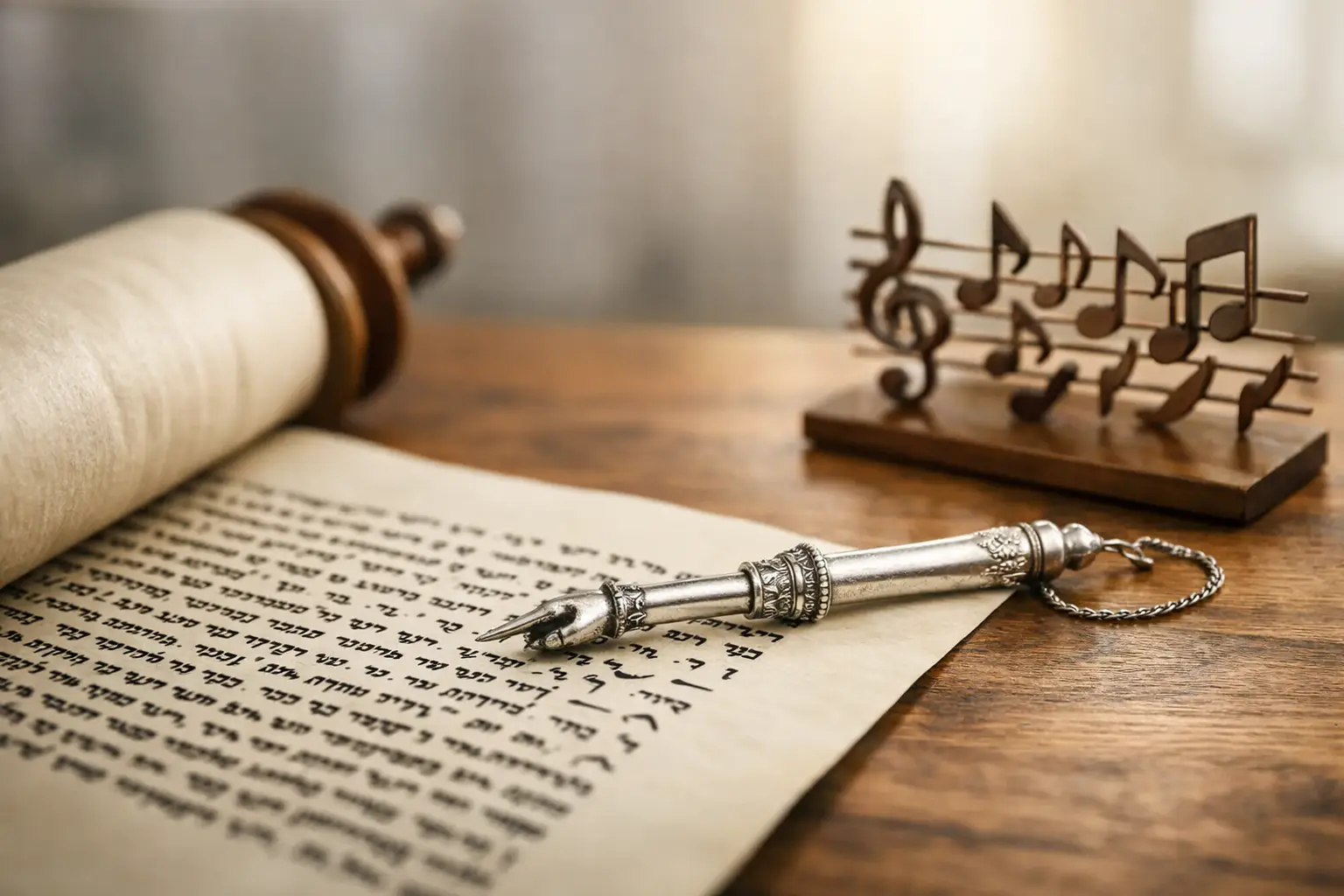
A biblical verse can look deceptively simple on the page. Beneath its familiar consonants and vowels, however, small signs hover above and below the letters, guiding a reader through pauses, connections, emphasis, and melody. This guide to Hebrew cantillation marks will help you begin seeing those signs not as decorative details, but as a remarkably intelligent reading system preserved alongside the sacred text.
For students of Biblical Hebrew, cantillation opens another doorway into the world of ancient Israel. It teaches us that Scripture was not only copied and studied. It was read aloud, heard in community, and carried by a tradition of careful attention. The marks do not replace grammar or vocabulary, but they often illuminate both.
What Are Hebrew Cantillation Marks?
Hebrew cantillation marks are commonly called te’amim, literally “tastes” or “accents.” In Ashkenazi Jewish settings, they are often called trop or trope. They appear in the Masoretic text of the Hebrew Bible, the text carefully transmitted by Jewish scribes and scholars known as the Masoretes.
Each mark has two primary jobs. First, it indicates something about how a passage is chanted in public reading. Second, and often more immediately useful to a beginning student, it signals the grammatical and rhetorical structure of a verse. Think of the te’amim as a system that does some of the work performed by commas, semicolons, parentheses, and vocal emphasis in English.
The same consonantal Hebrew text can be difficult to parse when read as an unbroken stream. Cantillation tells you which words belong together, where a clause turns, and where the reader should pause. In that sense, the marks are not merely musical notation. They are a map of interpretation.
Why a Guide to Hebrew Cantillation Marks Matters
Biblical Hebrew is famous for compact sentences. A few words may carry a whole scene, legal condition, prayer, or prophetic challenge. Because word order can be flexible and because Hebrew often omits what English speakers expect to see, the structure of a verse is not always obvious at first glance.
Consider the difference between saying, “Do not eat, children,” and “Do not eat children.” A pause changes everything. Biblical Hebrew rarely creates examples quite that dramatic, but the principle is real. Where a phrase is joined or divided can shape how we understand the relationship between verbs, subjects, objects, and descriptive clauses.
The Masoretes did not invent the Hebrew Bible’s meaning from scratch through these symbols. Still, their system records a highly developed Jewish tradition of how the text should be read. That makes it a valuable companion for serious students, clergy, teachers, and anyone who wants to encounter the Tanach with greater care.
Cantillation also restores something that silent reading can conceal: biblical texts have a voice. Narrative moves quickly or slows at a moment of tension. Poetry balances one line against another. A blessing gathers force before a final phrase. Even if you never learn to chant a full Torah portion, recognizing the accents can make your reading more attentive and alive.
The Basic Idea: Joining and Dividing
The most helpful first distinction is between conjunctive and disjunctive accents.
Conjunctive accents join words together. They tell the reader, in effect, “Keep moving. This word belongs closely with what follows.” A common conjunctive accent is merkha. You do not need to memorize every sign before you can benefit from the system. Start by noticing that some words lean forward into the next phrase.
Disjunctive accents divide phrases. They indicate pauses of varying strength. A minor disjunctive may be something like a comma, while a major one can function more like a semicolon or a period. The hierarchy matters. Not every pause ends a thought.
This is why a single English punctuation mark cannot perfectly translate a Hebrew accent. The te’amim form a layered structure. Smaller units gather under larger units, much as branches join a tree trunk. When you identify the strongest division in a verse, the rest of the verse often becomes easier to organize.
Two Marks to Learn First
If you are beginning to read cantillation as syntax, start with sof pasuq and etnahta.
Sof pasuq marks the end of a verse. It normally appears with the familiar two-dot symbol called silluq beneath the final accented word. Treat it as the verse’s full stop. This is often your first anchor when reading aloud.
Etnahta is usually the principal internal division of a verse. It often separates the verse into two large sections. In many cases, it functions like the main pause within a sentence. Find the etnahta, then ask: what comes before it, and what comes after it? That simple habit can prevent many rushed or confused readings.
For example, when a verse contains a long opening description followed by a decisive action, etnahta may separate the setting from the action. In poetry, it may divide two balanced thoughts. It does not always correspond neatly to an English comma, so let the Hebrew structure lead before forcing English expectations onto it.
Other Important Disjunctives
As your confidence grows, you will encounter accents such as zaqef qaton, tipcha, revia, and segolta. Their names, shapes, and melodies can feel like a great deal at once. There is no need to conquer them in a single week.
What matters first is their relative force. A word marked with a stronger disjunctive often serves as the head of a phrase. Nearby words with conjunctive marks tend to depend on it. Rather than asking only, “What is this symbol called?” ask, “What phrase is this symbol bringing to a pause?”
That question turns cantillation from a chart to memorize into a reading tool.
Cantillation, Melody, and Tradition
The musical side of cantillation is beautiful, but it requires one important qualification: there is no single universal tune. Jewish communities have preserved distinct chant traditions, including Ashkenazi, Sephardi, Yemenite, and others. The symbols are shared much more widely than any one melody.
The melody may also change depending on the biblical book and the occasion. Torah reading has one set of musical associations, while the books of Esther, Lamentations, and Ecclesiastes may be read with distinctive melodies suited to their character. A mournful reading of Lamentations, for instance, does not sound like the public proclamation of Torah.
For a learner approaching the text from an academic, Christian, Jewish, or interfaith setting, this diversity is a gift and a reminder of humility. Learn a tradition from a knowledgeable teacher or community rather than assuming one recording represents every Jewish practice. The marks can support your grammatical study, while the melodies introduce you to a living heritage of Jewish reading.
A Practical Way to Study the Marks
The best approach is gradual and text-centered. Do not begin by staring at a full chart of dozens of symbols. Begin with a short verse you already know well in English, perhaps from Genesis, Psalms, or Deuteronomy. Read the Hebrew aloud slowly, even if your pronunciation is still developing.
First locate the sof pasuq. Next, find the etnahta, if the verse has one. Read each side as a major unit. Then look for the smaller pauses and the words connected to them. Finally, compare what you see with the verse’s grammar: where is the main verb, who performs it, and which phrases modify it?
A useful study rhythm has four movements:
- Read the verse once for its overall sense.
- Mark its largest divisions, beginning with sof pasuq and etnahta.
- Identify the smaller phrase groups created by the remaining accents.
- Read it aloud again, allowing your voice to reflect the structure.
This practice should not become mechanical. Sometimes a familiar English translation will encourage you to pause in the wrong place. Sometimes the accents will reveal a relationship you had missed. At other times, the syntax is already clear and the marks simply confirm your reading. Both experiences are worthwhile.
Common Mistakes to Avoid
One common mistake is treating cantillation marks as optional decoration once you have learned vowel points. Vowels tell you how a word is pronounced; accents help tell you how words function together in a verse. They answer different questions.
Another mistake is assuming every accent has only one equivalent English punctuation mark. Hebrew and English organize sentences differently. The te’amim guide Hebrew phrasing, not a hidden English punctuation system.
Finally, do not confuse a cantillation mark with a word’s stress in every case. The accent often identifies the stressed syllable, but its syntactic role remains central. A mark can help you pronounce a word and position it within the larger thought at the same time.
Let the Text Be Heard
Learning Hebrew cantillation marks takes patience, especially when you are already working hard on vocabulary, verb forms, and translation. Yet even a modest familiarity with the system changes the experience of reading Scripture. The verse begins to breathe in phrases rather than sit flat on the page.
As you continue your exciting journey in Biblical Hebrew, return often to short passages and read them aloud. Let the accents slow you down, let the grammar become visible, and let the ancient voice of the text invite you to listen more closely.