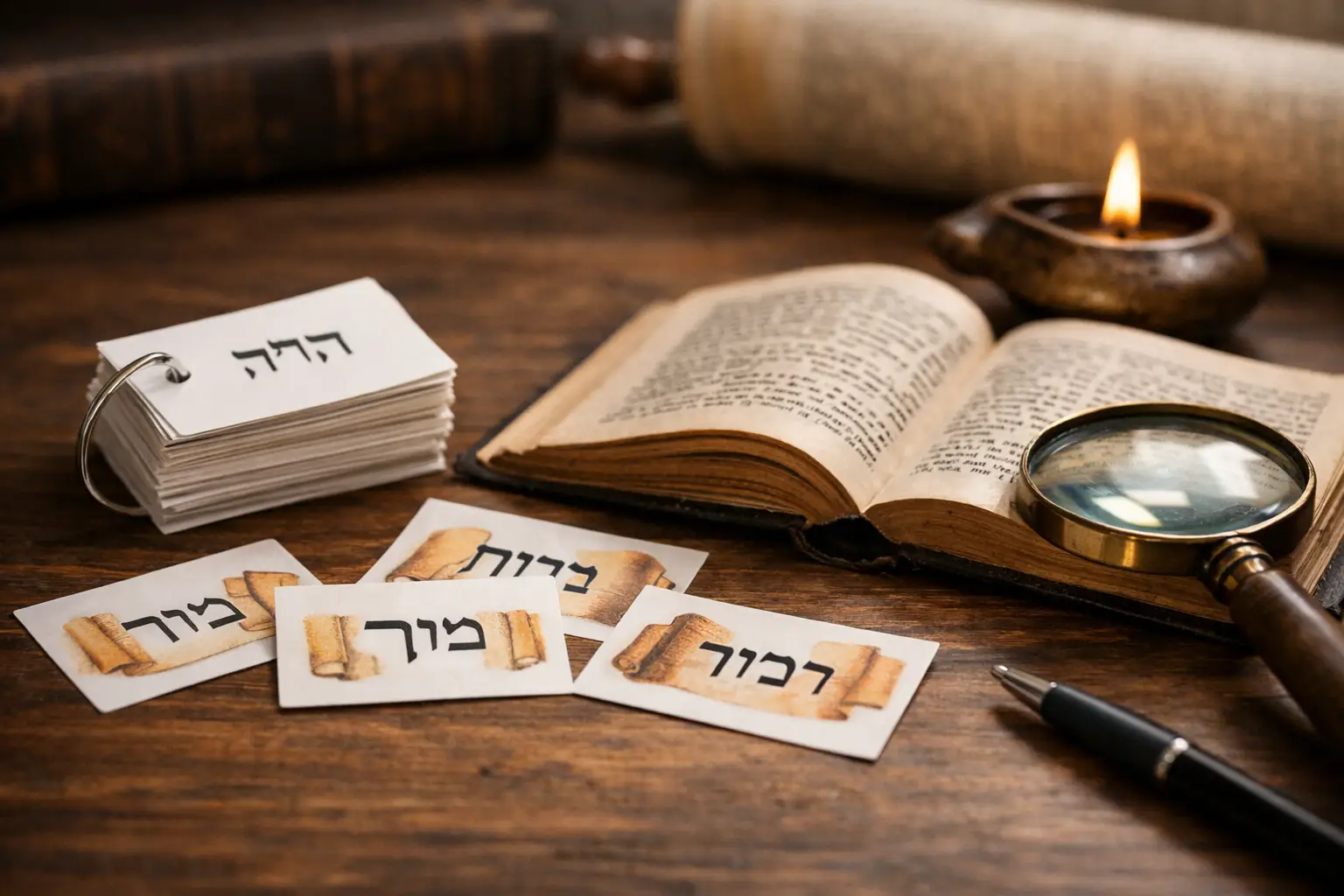
A flashcard that merely tells you that אֶרֶץ means “land” can help for an afternoon. A flashcard that lets you hear the word, notice its root, picture the land of Israel, and meet it again in a verse from the Tanach can stay with you for years. That difference is at the heart of the best Hebrew flashcard methods: they do not treat vocabulary as a pile of isolated translations. They help learners form living connections with the language of ancient Israel.
For students of Biblical Hebrew, vocabulary is not a side assignment to grammar. It is the material from which the biblical text speaks. The more readily words come to mind, the less time you spend decoding and the more you can attend to a passage’s syntax, poetry, repetition, and theological force. Good flashcards make that freedom possible, but only when they are designed for more than quick recognition.
The Best Hebrew Flashcard Methods Start With Recall
The familiar card format – Hebrew on one side, English on the other – is useful, especially at the beginning. Yet it produces a common illusion: you recognize a word when you see it and assume you know it. Reading Biblical Hebrew requires more. When you meet וַיֹּאמֶר in a narrative, you need to recognize it promptly as a form of אָמַר, “he said,” and understand what its prefixed conjunction and verbal pattern are doing.
Build cards in both directions. One card should show the Hebrew word and ask for its meaning. A second should give a brief English prompt and ask you to produce the Hebrew word aloud or in writing. Production is harder, which is precisely why it is valuable. It exposes the difference between “I have seen this before” and “this word is available to me.”
For verbs, avoid making a card that gives only a single English gloss. Biblical Hebrew verbs carry a great deal of their meaning in form. A useful card might present שָׁמַר and ask for its basic sense, “to keep, guard, observe,” while another presents יִשְׁמֹר and asks you to identify the root, stem, person, gender, number, and likely translation. At first this can feel slow. In time, it trains the eye to see a Hebrew word as a meaningful pattern rather than a mysterious string of letters.
Make Each Card Carry the Right Amount of Information
The temptation is to put every fact about a word on one card: definition, root, cognates, grammar, pronunciation, five verses, and a paragraph of commentary. That card may be fascinating, but it is difficult to review. A flashcard works best when it asks one clear question.
For a noun, the answer side can include the basic meaning, the plural or construct form if it is especially important, and a short biblical phrase. For example, a card for בַּיִת, “house,” might include בֵּית־דָּוִד, “the house of David.” The phrase gives the word a home in Scripture and introduces a form students will actually encounter.
For high-frequency verbs, use several small cards rather than one crowded card. One can teach the lexical form, another a common imperfect form, and another a striking occurrence in a verse. This approach respects the way Hebrew is learned: through repeated encounters with forms in meaningful settings.
There is also a practical question about vowel points. Beginners generally benefit from fully pointed words because the niqqud supports accurate pronunciation and distinguishes forms. As your reading confidence grows, include some cards without vowel points. Biblical manuscripts and many printed reference tools will not always provide the same level of vocalization support. Gradually learning to recognize the consonantal shape of a word prepares you for broader study without throwing you into the deep end too soon.
Use Roots as Memory Families, Not Shortcuts
The three-letter root is one of Hebrew’s great organizing gifts. When you learn כתב, you begin to notice the family: כָּתַב, “he wrote”; מִכְתָּב, “letter”; כְּתוּבָה, “writing” or “document.” Root-based cards can make vocabulary feel less like hundreds of unrelated items and more like a network of related ideas.
Still, roots should clarify rather than replace learning. Not every word’s meaning can be guessed accurately from its root, and related words may have developed distinctive meanings. Treat the root as a memory path, then learn each word on its own terms. This balance protects you from clever but unreliable wordplay.
Put Vocabulary Back Into the Biblical World
A word becomes memorable when it belongs to a scene. Instead of learning מִדְבָּר only as “wilderness,” picture the terrain east and south of the hill country: a place of grazing, travel, danger, dependence, and encounter. Instead of treating שֹׁפֵט as simply “judge,” remember that a biblical judge may be a leader and deliverer in a particular period of Israel’s history.
Add a concise context note to cards when context changes the way you understand the word. This is especially worthwhile for vocabulary tied to geography, worship, agriculture, family life, law, and royal administration. A card may note that גֹּאֵל is a “kinsman-redeemer,” a role embedded in family obligation, land, and justice. That is more faithful than a bare translation, yet still brief enough for review.
Verse cards are particularly powerful. Place a short phrase from a passage you are studying on the front, with one target word highlighted. On the back, give the word’s meaning, grammar, and a translation of the phrase. Repeatedly seeing vocabulary within biblical syntax helps students move from word memorization toward reading.
Choose verses with care. A vivid line from Genesis, Exodus, Ruth, Psalms, or Isaiah can become an anchor for a word. But do not overload early learners with difficult poetic constructions just because a verse is famous. The best example is one that strengthens the lesson currently in front of you.
Let Spaced Repetition Serve the Text
Spaced repetition means reviewing a card just before it is likely to fade from memory. Whether you use a paper box system or a digital program, the principle is the same: difficult cards return sooner; secure cards return less often. This is far more effective than rereading a large word list the night before class.
Digital flashcards are excellent for busy adults because they can turn short intervals into useful study: ten minutes before work, a few cards during a lunch break, a review before opening the Hebrew Bible. They also make it easy to include sound and to track which words need attention. Paper cards remain valuable for learners who remember through handwriting, color, and physical arrangement. Some students benefit from keeping the current week’s cards in hand and a larger review system on a device.
The tool matters less than consistency. Review a manageable number of cards daily, and introduce new words at a pace that leaves room for older vocabulary. A learner who adds fifty new cards but never revisits them is collecting exposure, not building memory. For many beginning students, ten to fifteen new items at a time is more fruitful than an ambitious flood.
Say the Words and Write Them
Biblical Hebrew is encountered primarily on the page, but it should not remain silent in your mind. Pronounce each card before turning it over. Read the syllables carefully. If you are learning with a teacher or recorded lesson, imitate the pronunciation you hear. Sound gives the letters another pathway into memory and makes word patterns easier to notice.
Writing is equally useful, particularly for letters that learners confuse, such as ב and כ, or final forms such as ך and ם. When a word repeatedly slips away, write it several times while saying it aloud and identifying its root. Then use it in a short phrase. This is not busywork. It joins visual recognition, physical movement, and sound into one act of learning.
Avoid Flashcard Habits That Weaken Learning
The most common mistake is treating every card marked “correct” as truly learned. If you hesitated for several seconds, guessed from a partial cue, or knew only a vague English association, mark the card as difficult. Honest review data is a gift because it tells you where your attention belongs.
Another mistake is learning a single English equivalent as though it were exhaustive. Hebrew words often have a range of meanings shaped by context. חֶסֶד may involve loyalty, kindness, covenant faithfulness, or steadfast love depending on the passage and translation tradition. Begin with a reliable core gloss, then let repeated reading expand your understanding.
Finally, do not allow flashcards to replace the joy of reading connected Hebrew. Cards are preparation for the text, not the destination. After a review session, open a verse and look for words you know. Even a short passage becomes more welcoming when familiar vocabulary begins to rise from the page.
A thoughtful flashcard practice can turn daily study into a small but genuine encounter with the language of the Tanach. Each remembered word is one more doorway into its stories, prayers, laws, and poetry – and one more reason to return to the text with alertness, reverence, and delight.