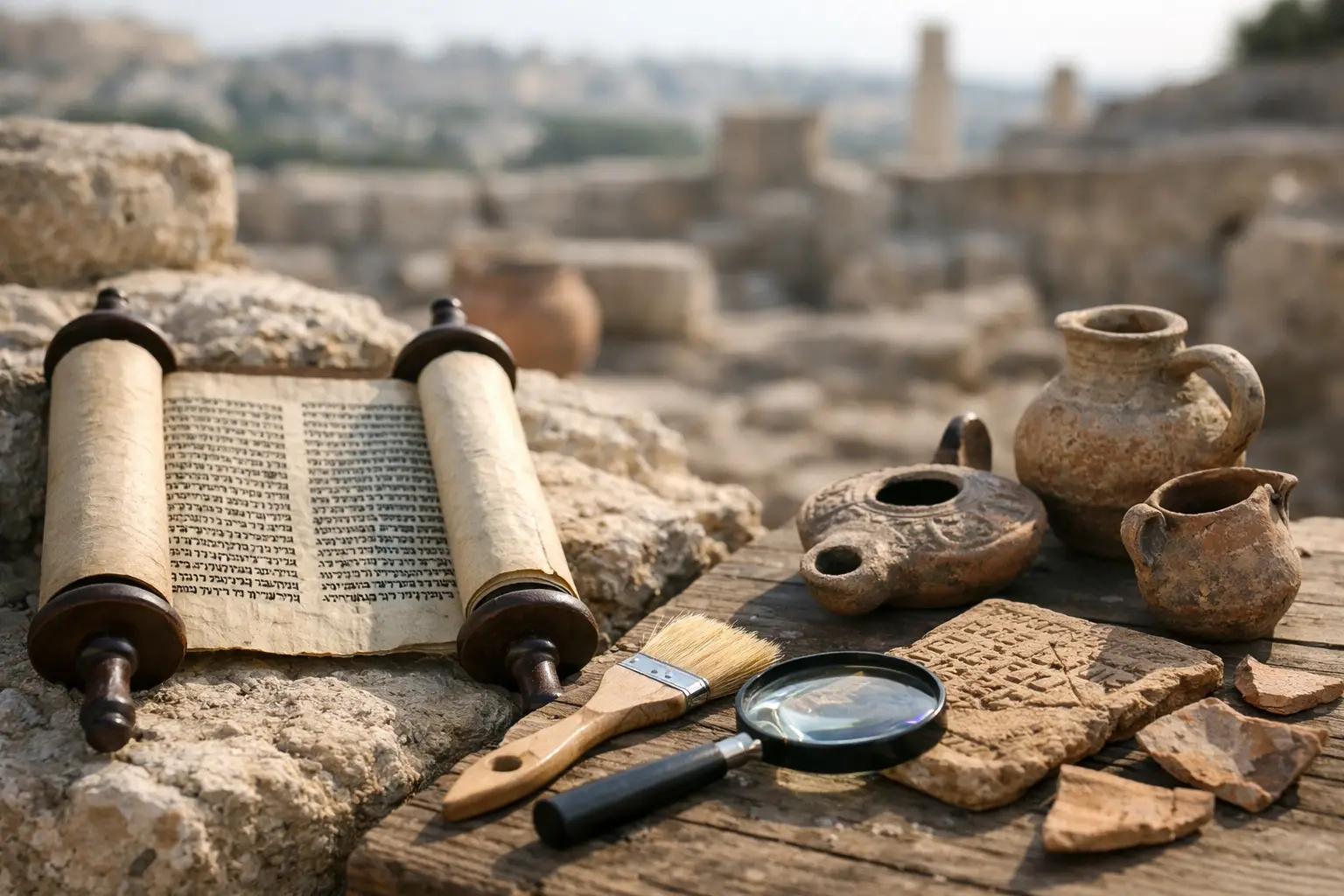
A clay letter breaks off mid-sentence. A tunnel inscription preserves the pride of workers who met beneath Jerusalem. A tiny silver amulet carries words that sound strikingly familiar to readers of Numbers. These artifacts do not merely decorate a Bible lesson. Biblical archaeology and Hebrew place us near the lived world in which the texts of ancient Israel were spoken, copied, sung, debated, and remembered.
For anyone who loves the Tanach, this meeting of language and material evidence can be one of the most exciting parts of study. Hebrew gives us access to the texture of the text: its repeated roots, compact phrases, wordplay, and verbal force. Archaeology gives those words a setting: homes, gates, seals, storage jars, inscriptions, roads, altars, and the terrain of the land itself. Together, they invite us to read with both intellectual care and a growing love for the language and culture of ancient Israel.
Biblical Archaeology and Hebrew: One Conversation
Archaeology studies physical remains from the past. It asks what people built, ate, traded, wrote, buried, repaired, and carried. Biblical Hebrew studies the language of much of the Hebrew Bible, along with related inscriptions from ancient Israel and Judah. They are distinct fields, and each requires its own methods. Yet they continually illuminate one another.
A biblical passage may mention a city gate, a winepress, a seal, or a household jar. Hebrew helps us ask what the particular word means in its literary context. Archaeology helps us picture the object or place without importing a modern assumption. A gate in an ancient city was not simply an entrance. It could be a commercial, legal, political, and social center. When elders sit at the gate in biblical narrative, the image carries public weight that becomes clearer when we understand how such spaces functioned.
The reverse is also true. When excavators uncover an inscription, Hebrew and its sister languages help identify names, titles, formulas, and everyday vocabulary. The ancient script may look unfamiliar at first. Early Hebrew letters are often written in Paleo-Hebrew, a script related to Phoenician, rather than the square Hebrew letters used in most printed Bibles today. Learning even a little about the language makes an inscription feel less like a museum label and more like a human voice.
Inscriptions Let Us Hear Ancient Voices
Most archaeological finds do not contain long texts. Often they preserve only a name, a number, a short blessing, or a line from an administrative record. Their brevity is part of what makes them precious. They give us ordinary writing from periods that can otherwise feel distant.
Consider the Lachish letters, a group of Hebrew ostraca, or inscribed pottery fragments, from the final years of the kingdom of Judah. These messages concern military conditions, communication, and uncertainty as Babylonian pressure intensified. They do not narrate the fall of Jerusalem in the manner of Kings or Jeremiah. Still, their language, names, and urgent practical concerns bring the political crisis into view at ground level. We meet officials and messengers trying to make sense of a dangerous moment.
The Siloam inscription offers another kind of encounter. Carved inside Hezekiah’s Tunnel in Jerusalem, it describes workers cutting through rock from opposite ends until they met. The inscription is brief, but its Hebrew is a reminder that infrastructure, engineering, royal planning, and public memory all belonged to the world behind the biblical text. When readers encounter accounts of Jerusalem’s water preparations, the tunnel is no longer an abstraction.
Then there are the silver amulets from Ketef Hinnom, tiny rolled inscriptions containing a blessing closely related to the priestly blessing in Numbers 6. They should not be treated as a shortcut for settling every question about biblical composition or dating. Such questions demand careful scholarly work. But the amulets do show that words of blessing associated with Israel’s God circulated in ancient Judah and were meaningful enough to be worn close to the body. Language here is not only literary. It is protective, personal, and devotional.
Hebrew Keeps Archaeology From Becoming a Collection of Props
It is easy to turn archaeology into a gallery of objects that supposedly “prove the Bible.” That approach usually asks too much of the evidence. A broken jar cannot prove the full theology of a prophetic book, and an excavation rarely resolves a complicated historical question by itself. Sites are incomplete, layers can be disturbed, and interpretations change as new evidence appears.
Hebrew study encourages a more patient posture. Words have ranges of meaning. Grammar conveys relationships that English translations may need several words to express. A term may function differently in poetry, law, narrative, or inscription. If an artifact appears to connect with a biblical phrase, the first question is not, “Have we found proof?” It is, “What can this evidence genuinely tell us, and what remains uncertain?”
This humility strengthens faith and learning rather than weakening them. The Bible does not need exaggerated claims. Its world is already compelling: a world of scribes, shepherds, farmers, royal officials, women managing households, pilgrims, prophets, artisans, and children. Archaeology helps recover the material setting; Hebrew lets us listen with greater precision.
Read the Land Alongside the Text
Biblical Hebrew is shaped by the land of Israel. Many words are concrete and earthy, rooted in agriculture, weather, family life, and movement across a rugged landscape. A word for hill country, wilderness, threshing floor, cistern, or inheritance carries associations that deepen when we understand the environment in which it was used.
Take the frequent biblical imagery of water. In a dry land, a spring, well, cistern, or seasonal stream is never merely background scenery. Each suggests a different source, a different vulnerability, and sometimes a different social reality. Archaeological study of water systems, terraces, and storage installations can sharpen our reading of metaphors about thirst, blessing, danger, and divine provision.
The same principle applies to homes and households. Excavated domestic spaces reveal grinding stones, ovens, loom weights, storage vessels, and small rooms arranged around shared activity. These finds do not tell us exactly what every Israelite family believed or how every biblical scene unfolded. They do, however, resist vague mental pictures. When a Hebrew text speaks of preparing grain, lighting a lamp, storing oil, or sitting within the household, these actions begin to occupy real space.
How to Study Both Without Getting Lost
A learner does not need to become a professional excavator before benefiting from archaeology. The best place to begin is with the Hebrew text itself. Read a short passage slowly. Notice repeated words, distinctive nouns, and details that seem ordinary. Then ask historical questions: What did this object look like? How would this activity have been done? What kind of landscape does the passage assume?
Choose reliable teaching that distinguishes evidence from speculation. A good instructor will say when an identification is debated, when a date is approximate, and when scholars disagree. This is especially necessary at famous sites, where a headline can travel much faster than a careful excavation report.
It also helps to learn a few core Hebrew roots deeply rather than collecting isolated vocabulary. Words such as בית, bayit, “house”; עיר, ir, “city”; דרך, derekh, “way”; מים, mayim, “water”; and ארץ, eretz, “land,” recur throughout the Bible and connect naturally to archaeology and geography. As their contexts accumulate, grammar becomes less like a set of detached rules and more like a means of entering an ancient world.
At Biblical Hebrew Teacher, this is the kind of connection that makes language study memorable: Hebrew is not confined to a chart of verb forms. It is a living gateway into the foundational book of ancient Israel and the wider world that formed it.
Let Curiosity Lead to Careful Reading
A photograph of an inscription, a reconstructed city gate, or a walk through an ancient water tunnel can awaken the desire to know more. Follow that desire back to the Hebrew words. Read them aloud. Ask why a root is repeated, why a noun is definite or indefinite, why a poet chose one image rather than another. Let the artifact make the text more specific, but let the text also keep the artifact from becoming silent stone.
The reward is not simply more information. It is the growing ability to encounter Scripture as a text rooted in real places and voiced in a real language. One Hebrew word, patiently learned, can become a doorway. On the other side stands ancient Israel in all its difficulty, beauty, memory, and enduring invitation.