A small shard of pottery can carry an enormous human presence. A name scratched into a jar handle, an order sent from a military outpost, or a plea written before a city fell can bring us astonishingly close to ancient Israel. Hebrew inscription analysis is the patient work of listening to those voices without forcing them to say more than the evidence allows.
For students of the Hebrew Bible, inscriptions are especially compelling because they place familiar words in unexpected settings. Biblical Hebrew appears in elevated poetry, law, prophecy, and narrative. Inscriptions often show Hebrew at work in vineyards, storehouses, gates, fortresses, households, and royal administration. They do not replace the Tanach. They help us see more clearly the linguistic and cultural world from which its texts emerged.
What Hebrew Inscription Analysis Actually Studies
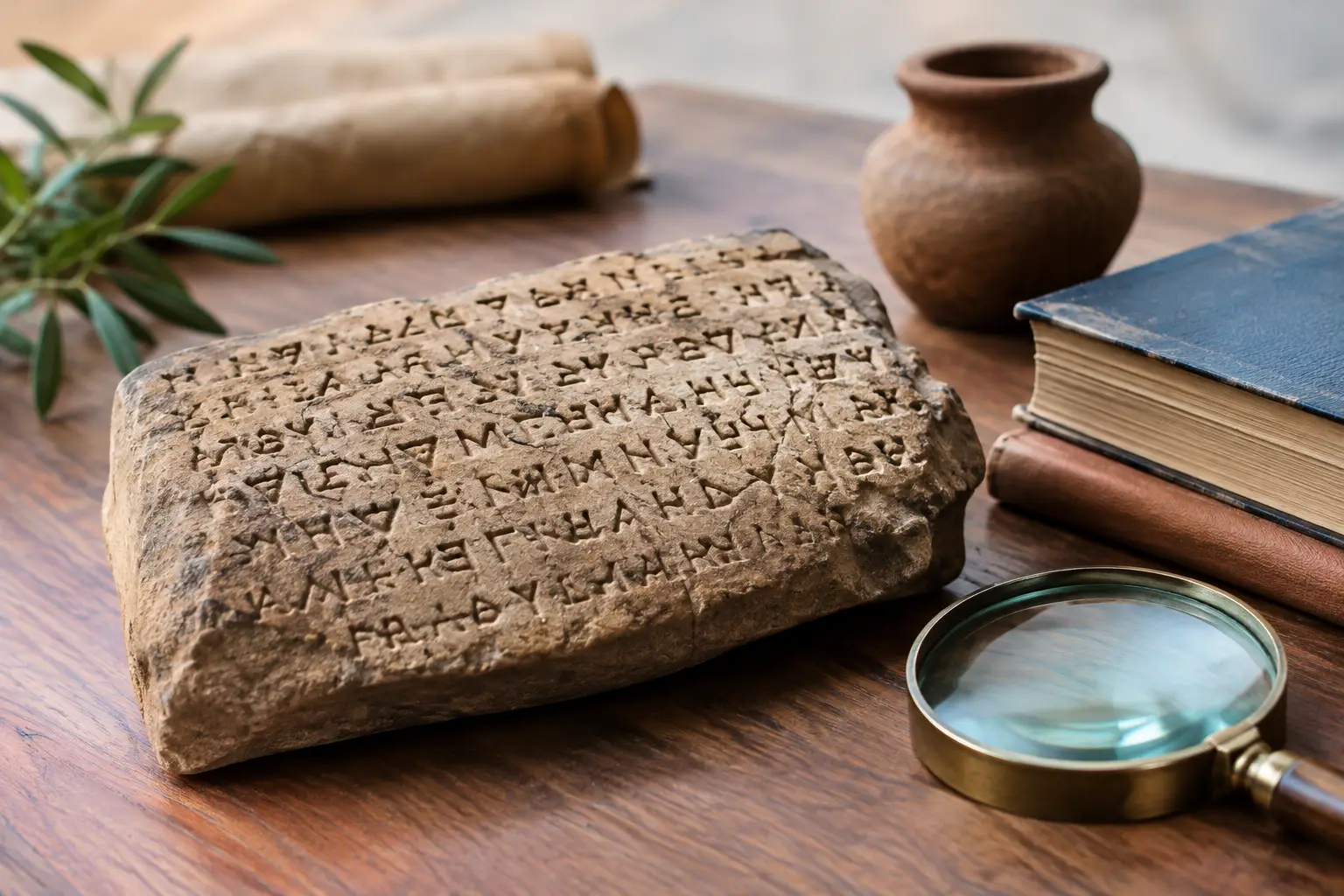
Hebrew inscription analysis belongs to the field of epigraphy, the study of writing on durable materials. The evidence may be carved into stone, incised on seals, stamped on jar handles, painted or scratched onto pottery, or written in ink on ostraca – broken pieces of pottery reused as economical writing surfaces.
The work begins before anyone translates a word. An inscription must be examined as an object. What material bears the writing? Where was it found? Was it discovered in a controlled archaeological excavation, or did it appear on the antiquities market with no documented origin? Which direction do the letters run? Are they written in ancient Hebrew script, Aramaic script, or a related alphabetic hand?
These questions are not academic decoration. A phrase without archaeological context can be difficult to date, interpret, or even authenticate. The more securely an inscription belongs to a known site and layer of occupation, the more confidently it can illuminate a particular historical setting.
The First Challenge: Reading the Letters
Ancient Hebrew inscriptions do not look like a modern printed Hebrew Bible. Most Iron Age Hebrew texts use what scholars call paleo-Hebrew script, an ancestor of the familiar square Hebrew letters used today. A learner who knows א, ב, ג, and ד in a modern typeface has made a valuable start, but must still learn to recognize their earlier forms.
That task is harder than it first appears. Letters can be faded, chipped, crowded together, or distorted by the curve of a pottery sherd. A waw and a yod may be difficult to distinguish. A damaged stroke might belong to a he, a het, or no letter at all. Ink can disappear into the color and texture of clay.
This is why careful editions often use brackets, dots, and question marks. Brackets may indicate restored letters where the surface is broken. A dot beneath a letter can signal uncertainty. These marks are not signs of scholarly weakness. They are acts of honesty. They tell the reader where the artifact speaks clearly and where interpretation begins.
Paleography, the study of letter forms, helps researchers compare a script with other dated examples. Letter shape can suggest a general period, much as handwriting can suggest a generation or setting. Yet paleography usually offers ranges, not mathematical certainty. A scribe may write conservatively, locally, quickly, or idiosyncratically. Dating becomes stronger when script, archaeology, language, and historical context point in the same direction.
From Consonants to Meaning
Once the letters have been read, the familiar work of Hebrew study begins, though with special complications. Ancient Hebrew writing often records chiefly consonants. Vowel points were added many centuries later, so an inscription normally gives no direct vocalization. Word division may be inconsistent. Spelling can be fuller or shorter than the spelling found in the Masoretic Text.
A short sequence of consonants can therefore invite several possibilities. Grammar narrows the options, but context often decides between them. Is a word a personal name, a place name, a verb, or an administrative term? Is a final letter part of the word, an abbreviation, or the beginning of the next line? A translation that looks effortless on a museum label may rest on many small judgments.
Consider how much context changes an ordinary word. The Hebrew word for wine may appear in a prophetic image, a legal instruction, a psalm, or a storage notation on a jar. Its basic meaning remains recognizable, but the social world around it changes. On a jar inscription, it may tell us about taxation, distribution, supply, or ownership. The language becomes wonderfully concrete.
Names deserve attention as well. Theophoric names, which incorporate an element referring to God, can offer clues to patterns of devotion and identity. Names containing forms related to YHWH, El, Baal, or other divine elements must be read with historical care. A name can indicate family tradition or cultural environment, but it does not automatically describe a person’s private beliefs.
Context Protects Us From Easy Claims
The most exciting inscriptions are often the most vulnerable to exaggeration. When a text seems to mention a biblical king, a familiar place, or a divine name, headlines can outrun the evidence. A responsible reader asks not only, “What does this say?” but also, “How secure is the reading, and what would this prove if correct?”
The Tel Dan Stele, for example, is frequently discussed because of its probable reference to the “House of David.” Its importance lies not in turning archaeology into a shortcut around careful historical study, but in contributing an extrabiblical witness to a Davidic royal dynasty. Its broken condition and debated details remind us why modest claims are stronger than sensational ones.
The Lachish letters offer another vivid window. These ostraca, written in the final years of the kingdom of Judah, preserve correspondence associated with a pressured military environment. Their language is not the language of a polished biblical narrative. It is urgent, practical, and personal. Reading them beside the prophetic books does not flatten the differences between genres. It deepens our sense of the tense world in which warnings, alliances, sieges, and loyalties mattered.
There is also the crucial matter of provenance. An unprovenanced artifact may be genuine, but its historical value is sharply limited because we do not know where it was found or what objects surrounded it. It may also be harder to test against forgery. The desire for a dramatic confirmation must never overcome the discipline of asking where an object came from.
A Faithful Method for Beginning Students
Students do not need to become professional epigraphers before they can benefit from inscriptions. They do, however, need a disciplined sequence of questions. A sound first encounter moves from the visible object to the historical setting, then to the letters, grammar, and interpretation.
When you meet an inscription, begin by observing rather than translating. Notice its material, size, layout, damage, line direction, and script. Next, identify what is known about its discovery and date. Only then work through a transcription, comparing each letter with a script chart and noting every uncertain place.
After that, parse the Hebrew as you would a biblical verse, while resisting the temptation to supply later vowel patterns automatically. Ask whether the spelling reflects an older form, a regional practice, or a scribal convention. Finally, read the inscription within its likely social setting. A receipt, seal, curse formula, dedicatory text, and military letter each use language for different purposes.
This method is slower than searching for a quick translation. It is also more rewarding. The goal is not merely to collect archaeological trivia that “proves” something familiar. The goal is to grow in attentive reading. Every fragment asks us to honor both its clarity and its limits.
Why Inscriptions Enrich Biblical Hebrew Study
Biblical Hebrew can sometimes feel distant when encountered only through paradigms and vocabulary lists. Inscriptions return us to the texture of real writing. They show that the language of the prophets and psalmists was also the language of names on seals, shipments of oil, official messages, and ordinary human concerns.
They can sharpen grammatical instincts. A student begins to recognize that spelling varies, that idioms live within communities, and that language changes over time. They also encourage humility. The Hebrew Bible is a magnificent literary and theological collection, while inscriptions are often brief and fragmentary. Their relationship is illuminating, but never simplistic.
At Biblical Hebrew Teacher, this is part of the exciting journey of learning the language as a gateway into ancient Israel. Grammar matters deeply, but grammar becomes more memorable when it opens a door to a fortress letter, a seal impression, or the worn surface of a jar once held by an ancient hand.
The next time you encounter a Hebrew inscription, linger over its broken edges and imperfect letters. Before asking whether it confirms a familiar passage, ask whose daily world it preserves. That question can lead you toward a more patient love for Hebrew, for the people who wrote it, and for the ancient texts that still invite us to read closely.