The Dead Sea Scrolls do not speak with one voice. They preserve biblical manuscripts, community rules, prayers, visionary writings, legal debates, and interpretations of Scripture from the last centuries before and first century after the Common Era. That variety is precisely why choosing among the best Dead Sea Scrolls translations matters. A translation ideal for reading the Community Rule over morning coffee may not be the one you want beside an open Hebrew Bible and a notebook.
For students of Biblical Hebrew, the Scrolls are especially exciting. They place us near the world in which the Hebrew Bible was copied, interpreted, prayed, and argued over. Their Hebrew is not identical to biblical Hebrew, and their ideas do not represent all ancient Judaism. Yet they let us overhear a Jewish community wrestling intensely with covenant, purity, calendar, prophecy, and hope.
There Is No Single “Best” Translation
Before naming books, one distinction will save considerable frustration: some editions translate the nonbiblical scrolls, some focus on the biblical manuscripts, and some pair translation with Hebrew or Aramaic transcription. The best choice depends on what you hope to do.
A first-time reader often needs lucid English, brief introductions, and enough notes to identify unfamiliar terms. A seminary student may need fragment numbers, variant readings, and a clearer account of editorial decisions. A Hebrew learner benefits greatly from an edition that puts the original language close at hand, even if the page initially feels more demanding.
Translation itself involves difficult decisions. Many scrolls survive only in fragments. A translator must indicate missing text, decide how much reconstruction to print, and choose English that reflects either the roughness or the literary force of the original. No English volume removes those questions. The finest ones make them visible without making the reader feel shut out.
The Best Dead Sea Scrolls Translations for Different Readers
1. The Dead Sea Scrolls: A New Translation by Michael Wise, Martin Abegg Jr., and Edward Cook
For many readers, this is the strongest place to begin. Wise, Abegg, and Cook offer a broad collection of nonbiblical scrolls in clear, energetic English. The volume includes famous works such as the Community Rule, the War Scroll, the Thanksgiving Hymns, the Damascus Document, and the pesharim, or commentaries on biblical books.
Its great strength is readability. The translators give these ancient writings enough literary shape that a newcomer can follow their argument and emotional texture. The introductions and notes provide orientation without turning every page into a technical obstacle course.
The trade-off is that serious textual study eventually asks for more. Readers comparing a translation closely with Hebrew, Aramaic, or scholarly editions will want fuller information about variants and reconstruction. Still, for a class, church study group, homeschool family, or independent learner beginning the journey, this is an excellent first volume.
2. The Dead Sea Scrolls Study Edition by Florentino García Martínez and Eibert J. C. Tigchelaar
If your aim is sustained study, this two-volume edition belongs near the top of the list. It presents transcriptions of the Hebrew and Aramaic texts alongside English translations. That format makes it unusually valuable for learners who want to move from English understanding toward direct engagement with the ancient languages.
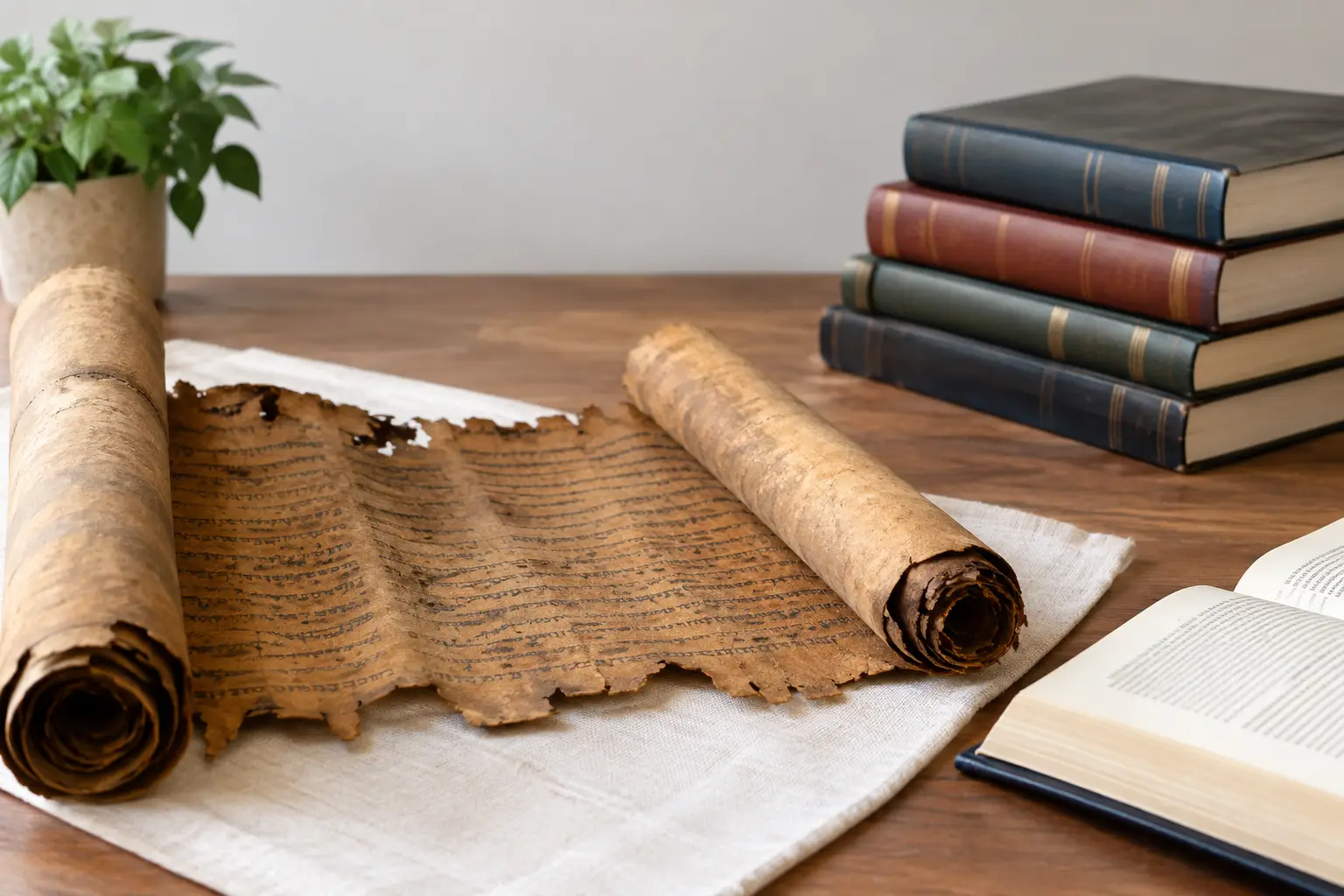
The experience is different from reading a popular anthology. You will encounter brackets, gaps, columns, fragment designations, and the physical reality of damaged manuscripts. At first, this can feel intimidating. But it teaches an essential lesson: the Dead Sea Scrolls are not simply a set of polished books waiting to be read. They are archaeological texts, often broken, whose interpretation requires patience.
For Biblical Hebrew students, this edition can become a remarkable workshop. Read a short passage in English first. Then locate recurring Hebrew words such as ברית, berit, covenant; תורה, torah, instruction; or אור, or, light. Notice where the spelling differs from the Masoretic Text or where a familiar biblical phrase is given fresh emphasis. A teacher can help make those observations more fruitful, but even a beginning student can start seeing patterns.
3. The Dead Sea Scrolls Bible by Martin Abegg Jr., Peter Flint, and Eugene Ulrich
This is the best choice when your central question is biblical: what do the Scrolls show us about the text of the Hebrew Bible? Rather than translating the sectarian and other nonbiblical works, this volume gathers biblical manuscripts found among the Scrolls and presents them in English, with attention to differences from traditional biblical texts.
That focus is invaluable. The Scrolls include manuscripts of nearly every book of the Hebrew Bible, with Esther being the notable exception. They demonstrate both remarkable continuity and real textual diversity. Some readings closely resemble the later Masoretic Text; others align more closely with the Greek Septuagint or Samaritan Pentateuch; still others stand independently.
This book should not be treated as a replacement for a standard Bible translation. Its purpose is comparative. Read a passage in your preferred English Bible, then consult the Dead Sea Scrolls Bible to see whether an ancient manuscript offers another wording, a longer reading, or a different arrangement. The result is not a reason for anxiety about Scripture. It is an invitation to appreciate the long, careful, and sometimes complex history of its transmission.
4. The Complete Dead Sea Scrolls in English by Geza Vermes
Geza Vermes introduced generations of readers to the Scrolls. His translation remains a compelling, accessible one-volume companion, especially for those who want to encounter the literature as a coherent body of religious writings rather than as a technical textual archive.
Vermes writes with confidence and clarity. His framing of the Qumran community and its beliefs has shaped popular understanding of the Scrolls for decades. That makes the book historically significant as well as enjoyable to read.
Yet readers should remember that Scroll scholarship has changed substantially since the earliest editions of Vermes’s work. New discoveries, improved readings, and continuing debates have refined scholarly judgments. Use Vermes for a readable, influential guide, but pair it with a newer translation if you are doing detailed research or preparing to teach others.
5. The Dead Sea Scrolls: A Very Short Introduction is not a translation, but it may be the companion you need
This is not one of the translations themselves, and it should not be purchased in place of one. Still, readers often struggle not because the English is difficult, but because they lack context. Who produced these texts? Were they written at Qumran? What was the relationship between the site, the caves, and the wider Jewish world?
A concise scholarly introduction can answer those questions before they become distractions. The major issue is that the identity of the Qumran community remains debated. The familiar description of the group as Essenes may be plausible, but it is not a settled fact beyond discussion. Good study keeps that uncertainty in view.
A Simple Path for Hebrew Learners
The Scrolls become far more memorable when they are read slowly and in context. Begin with an accessible translation such as Wise, Abegg, and Cook. Choose one short text – the Community Rule is a natural starting point – and read it as literature. What kind of community does it imagine? What does it praise? What does it fear?
Next, compare its vocabulary with the Tanach. The phrase “sons of light,” בני אור, bene or, recalls biblical imagery while taking on a distinctive communal intensity. Prophetic language, especially from Isaiah, Habakkuk, and the Psalms, appears again and again. The writers do not merely quote Scripture. They inhabit it, applying ancient prophetic words to their own contested moment in history.
Then move to García Martínez and Tigchelaar for a few lines of the original. Do not expect instant fluency. Look for roots you know, conjunctions, pronouns, repeated formulas, and familiar suffixes. This is where Biblical Hebrew becomes a living gateway into ancient Israel’s language and culture rather than a stack of grammar exercises.
What to Watch for When Comparing Translations
When two translations differ, resist the urge to assume one must be careless. Sometimes one translator has chosen smoother English, while another has preserved an ambiguous Hebrew phrase. At other times, the underlying manuscript is damaged and the words in brackets represent a scholarly reconstruction.
Pay close attention to editorial symbols. Square brackets often indicate restored text. Ellipses or blank spaces may mark a lacuna, where the manuscript has been lost. Fragment and column numbers are not decoration. They allow scholars and students to identify exactly where a passage comes from and compare it with other editions.
Also remember that “the Scrolls” are not a single theological system. The library contains diverse texts, copied by different hands and preserved over time. It is wiser to say, “This scroll presents this idea,” than to make sweeping claims about what every Dead Sea Scroll believed.
Which Volume Should You Buy First?
If you want one readable book, choose The Dead Sea Scrolls: A New Translation. If you are studying Biblical Hebrew or preparing serious research, choose The Dead Sea Scrolls Study Edition. If your interest centers on textual variants in the Hebrew Bible, choose The Dead Sea Scrolls Bible. If you want an influential classic for sustained reading, Vermes is still worth having, ideally alongside a newer resource.
The finest translation is finally the one that brings you back to the text with greater care. Read the Scrolls not as secret codes or curiosities, but as witnesses to real communities who loved Israel’s Scriptures enough to copy them, interpret them, and build their lives around them. That encounter can deepen both your Hebrew study and your sense of the living world behind the Bible.