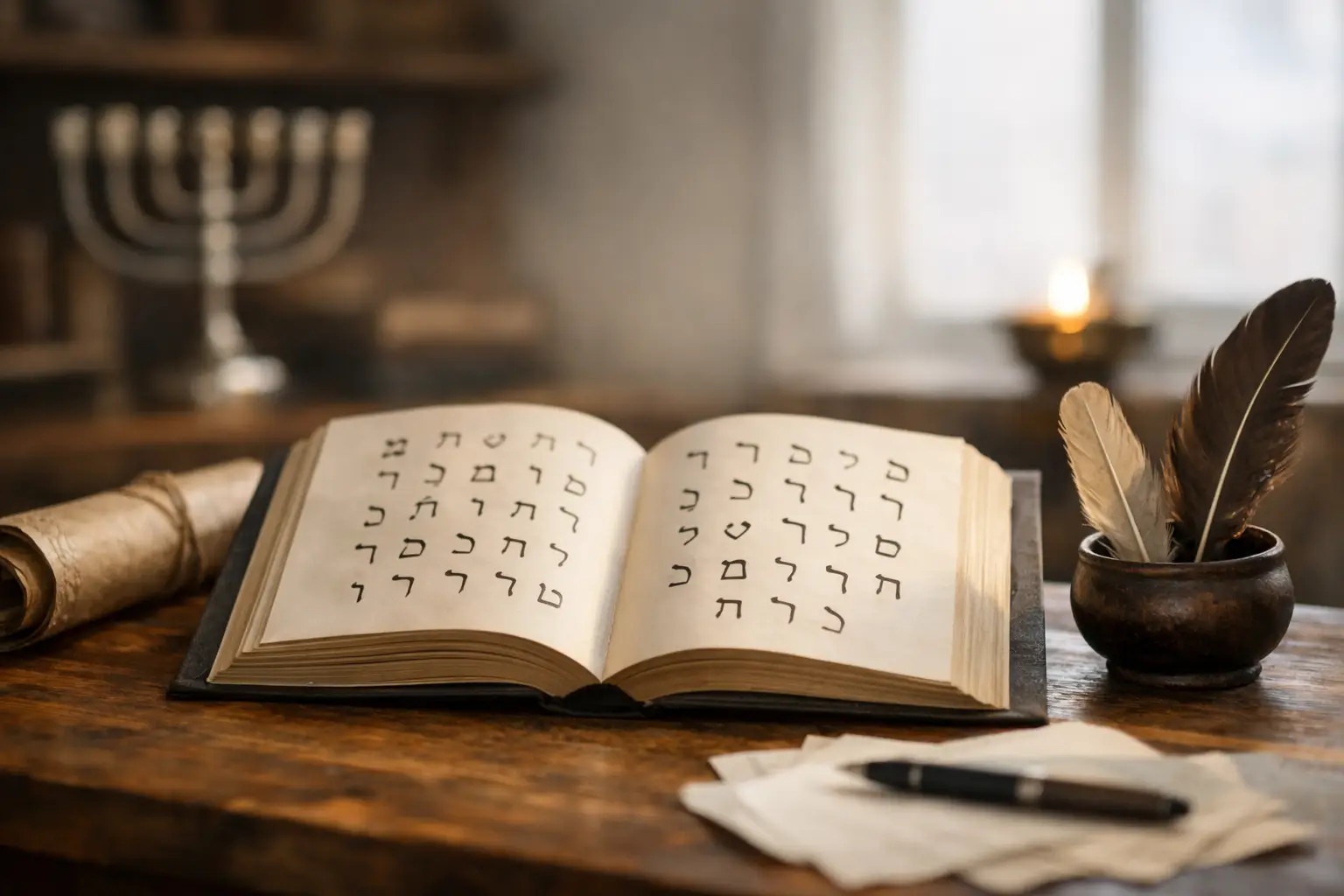
The first time you sound out a Hebrew word from the Bible, something shifts. The text stops being a distant translation on a page and becomes a language with texture, rhythm, and memory. A good guide to Hebrew alphabet pronunciation does more than help you say letters correctly – it opens a doorway into the sound-world of ancient Israel.
If you are beginning Biblical Hebrew, pronunciation can feel deceptively simple. There are only twenty-two letters, but several of them change sound depending on dots, position, or historical tradition. Add vowels, gutturals, and the question of Ashkenazi, Sephardi, Israeli, or reconstructed Biblical pronunciation, and many learners begin to wonder whether there is one “right” way to say Hebrew at all. The honest answer is that there are standards, and there are also traditions. Learning the difference will save you frustration.
What this guide to Hebrew alphabet pronunciation should do for you
At the start, your goal is not to settle every historical debate. Your goal is to read accurately, hear distinctions that matter, and build habits that will serve you when you encounter real Biblical texts. Pronunciation is foundational because Hebrew is not merely a code to decode. It is a language shaped by poetry, liturgy, memory, and the life of a people.
For that reason, beginners do best when they learn three things together: the names of the letters, the most common sounds of the letters, and the places where pronunciation varies by tradition. That combination gives you something sturdy enough to begin reading, while also keeping you honest about the fact that Biblical Hebrew reaches us through living communities and long histories.
The Hebrew alphabet at a glance
Hebrew is written from right to left and built on consonants. The alphabet has twenty-two letters. Five of those letters have a special final form used at the end of a word. In early learning, it helps to think of the system as stable but not perfectly one-to-one with English. Some letters sound familiar, while others have no exact English equivalent.
The letters are: aleph, bet, gimel, dalet, he, vav, zayin, het, tet, yod, kaf, lamed, mem, nun, samekh, ayin, pe, tsade, qof, resh, shin, and tav. Final forms appear with kaf, mem, nun, pe, and tsade.
Several letters deserve special attention from the beginning. Bet can sound like b or v. Kaf can sound like k or kh. Pe can sound like p or f. Shin can sound like sh, while sin, marked differently, sounds like s. These are not random exceptions. They are part of the logic of the writing system.
The letters that usually feel easiest
Many Hebrew letters have straightforward approximations in English. Bet with a dagesh is like b in boy. Gimel is generally like g in go. Dalet is d. He is h. Zayin is z. Lamed is l. Mem is m. Nun is n. Samekh is s. Pe with a dagesh is p. Qof is often taught like k for beginners, though historically it was likely deeper in the throat than kaf. Tav in most modern teaching traditions is t.
This is good news for new students. You do not need to master every subtlety before you begin reading words. You need a stable first pass.
The letters English speakers need to practice
This is where pronunciation becomes exciting. Hebrew preserves sounds that remind us we are entering a different linguistic world.
Aleph and ayin
Aleph and ayin are often difficult for English speakers because, in many classroom settings, they seem almost silent. Aleph originally represented a glottal stop, a brief catch in the throat. Ayin was a voiced guttural sound much deeper than anything in standard English. In many contemporary pronunciations, especially among beginners, both are treated lightly. That is understandable, but it can flatten important distinctions.
Even if you do not produce a strong historical ayin, it helps to recognize that these letters are not decorative. They shape syllables and often preserve traces of older pronunciation traditions.
Het and khaf
Het and khaf without a dagesh are usually pronounced like the ch in the German Bach or the Scottish loch. This sound is not the English ch of church. It is a friction sound made in the throat or back of the mouth. Students often avoid it at first, but it becomes natural with repetition.
Het is always this guttural sound. Khaf, the soft form of kaf, has a closely related sound. In some traditions they are distinct, and in others they are pronounced almost the same. For beginners, producing a clear throaty kh sound for both is a solid start.
Resh
Resh varies widely. In modern Israeli Hebrew it is often uvular, produced farther back in the mouth. In older or other traditional settings, it may be rolled or tapped more like a Spanish r. For Biblical Hebrew study, either can work if you are consistent. What matters most is recognizing the letter and not turning it into an English r so heavily that it distorts the flow of Hebrew words.
Tsade
Tsade sounds like ts in cats. English speakers can do this sound, but they sometimes add an extra vowel before it, especially at the start of a word. Resist that urge. Tsade is a consonant cluster sound, clean and direct.
Begadkephat letters and the dagesh
One of the most important patterns in any guide to Hebrew alphabet pronunciation is the group called begadkephat: bet, gimel, dalet, kaf, pe, and tav. Historically, these letters could have harder or softer pronunciations depending on context, often marked by a dot called a dagesh.
For most beginning Biblical Hebrew students today, the practical changes you must know are bet/bet-vet, kaf/khaf, and pe/fe. Bet with a dot is b, without it is v. Kaf with a dot is k, without it is kh. Pe with a dot is p, without it is f.
Gimel, dalet, and tav are more complicated historically. Some traditions preserve softer forms, while many modern classroom systems do not. That means you may hear different teachers pronounce the same letter differently in advanced or historically sensitive settings. This is not a sign that someone is careless. It reflects the long journey of the language.
Vowels matter more than beginners expect
The Hebrew alphabet is often called a consonantal alphabet, but Biblical Hebrew is usually taught with vowel signs called niqqud. These dots and marks below, above, or inside the letters guide pronunciation.
At the beginning, do not overcomplicate the vowels. Learn the common values clearly: ah, eh, ee, oh, oo, and very short reduced vowels called sheva or hatef vowels. Different teaching traditions may merge some vowel distinctions in speech, especially because modern Israeli pronunciation does not preserve every ancient difference. Still, when reading Biblical Hebrew, it is wise to learn the written distinctions carefully. They often carry grammatical significance even when the spoken difference is subtle.
A learner who pronounces every qamats exactly like every patah may still be understood in class, but that learner could miss patterns that matter later in verbs and nouns. Pronunciation and grammar are closer companions than they first appear.
Which pronunciation tradition should you use?
This is the question many serious students ask, and it deserves a careful answer. There is no single universally enforced pronunciation for Biblical Hebrew study. In practice, most students in the US encounter one of three approaches.
A modern Israeli-style pronunciation is common because it is teachable, widely heard, and useful if you also want access to contemporary Hebrew. A more liturgical Ashkenazi or Sephardi-style pronunciation may appear in religious settings. A historically reconstructed Biblical pronunciation aims to recover older sound distinctions as much as possible, though even scholars debate details.
So what should you choose? If your main goal is to begin reading the Hebrew Bible with confidence, choose a consistent system used by a skilled teacher and stay with it long enough to build fluency. If your interest is historical linguistics, then a more reconstructed approach may be worth the extra effort. If you study in a synagogue, church, or academic program, it often makes sense to learn the local convention first and then notice where it differs from others.
The trade-off is simple. A reconstructed system may be historically richer, but harder to sustain without community reinforcement. A modern Israeli-based system may be easier to practice consistently, but it smooths over some older distinctions.
How to practice so the sounds stick
Pronunciation improves through hearing, repetition, and memory. Read the alphabet aloud daily. Pair each letter with a key sound and a sample word. Practice confusing pairs together, such as bet and vet, kaf and khaf, shin and sin, aleph and ayin.
It also helps to read slowly from pointed Biblical Hebrew texts instead of isolated charts forever. Real words train your eye and ear together. Say them aloud. Hear where the stress falls. Notice how gutturals affect nearby vowels. Over time, what felt foreign begins to feel ordered.
Most students improve faster when they practice with a live model rather than only a chart. Pronunciation is physical. You often need to hear a sound, try it, adjust it, and try again. That is one reason thoughtful instruction matters so much. At Biblical Hebrew Teacher, this is part of the joy of learning – not just memorizing symbols, but entering the language in a way that is accurate, memorable, and alive.
Common beginner mistakes
The most common mistake is trying to force Hebrew sounds into neat English equivalents. Hebrew is close enough to seem familiar and different enough to punish overconfidence. Another common problem is inconsistency. Students switch between systems without realizing it, which creates confusion later.
A third mistake is treating pronunciation as cosmetic. It is not. Pronunciation shapes how you read, remember, and eventually interpret. When you hear the difference between similar forms, morphology becomes easier. When you feel the rhythm of a verse, the poetry begins to breathe.
If you keep that in view, the alphabet stops being a hurdle and becomes the beginning of a relationship with the text. Learn the letters carefully, respect the traditions behind them, and let your mouth become a place where ancient words are heard again.