A good video biblical hebrew course should do more than march you through verb charts. It should help you hear the texture of the language, recognize patterns with confidence, and begin reading the Hebrew Bible as a real body of literature shaped by the world of ancient Israel. If a course leaves you with isolated rules but no sense of the text, the culture, or the joy of discovery, it is asking too little of Biblical Hebrew and too much of your patience.
That matters because most students do not come to Hebrew for grammar alone. They come because they want to understand a verse more deeply, teach scripture more responsibly, prepare for seminary, enrich family study, or stand closer to the foundational book of ancient Israel and the wider Western tradition. A video course can serve those goals beautifully, but only if it is built by someone who knows that language study is never just about memorizing endings.
What a video biblical hebrew course should actually teach
The first question is simple: what is the course trying to form in the learner? Some courses are essentially digital workbooks. They present the alphabet, a sequence of grammar topics, and a set of quizzes. That can be useful, especially for highly self-directed learners, but it often produces a thin kind of knowledge. Students may recognize terminology without being able to move through a verse with confidence.
A stronger approach treats Hebrew as a living gateway into the language, texts, and culture of ancient Israel. That does not mean pretending Biblical Hebrew is modern spoken Hebrew. It means teaching it as a meaningful system used by real people in real historical settings. When instruction includes pronunciation, recurring word patterns, syntax, literary features, and the historical world behind the text, students retain more and understand more.
You should expect a course to teach the building blocks clearly: alphabet, vowels, syllables, common vocabulary, noun patterns, pronominal suffixes, verbal systems, and sentence structure. But you should also expect it to show why those pieces matter. What changes when a verb form shifts? Why does a poetic line compress grammar? How does a repeated root create resonance in a passage? Those are the moments when Hebrew stops feeling like a code and starts feeling like language.
The best video biblical hebrew course is not only about convenience
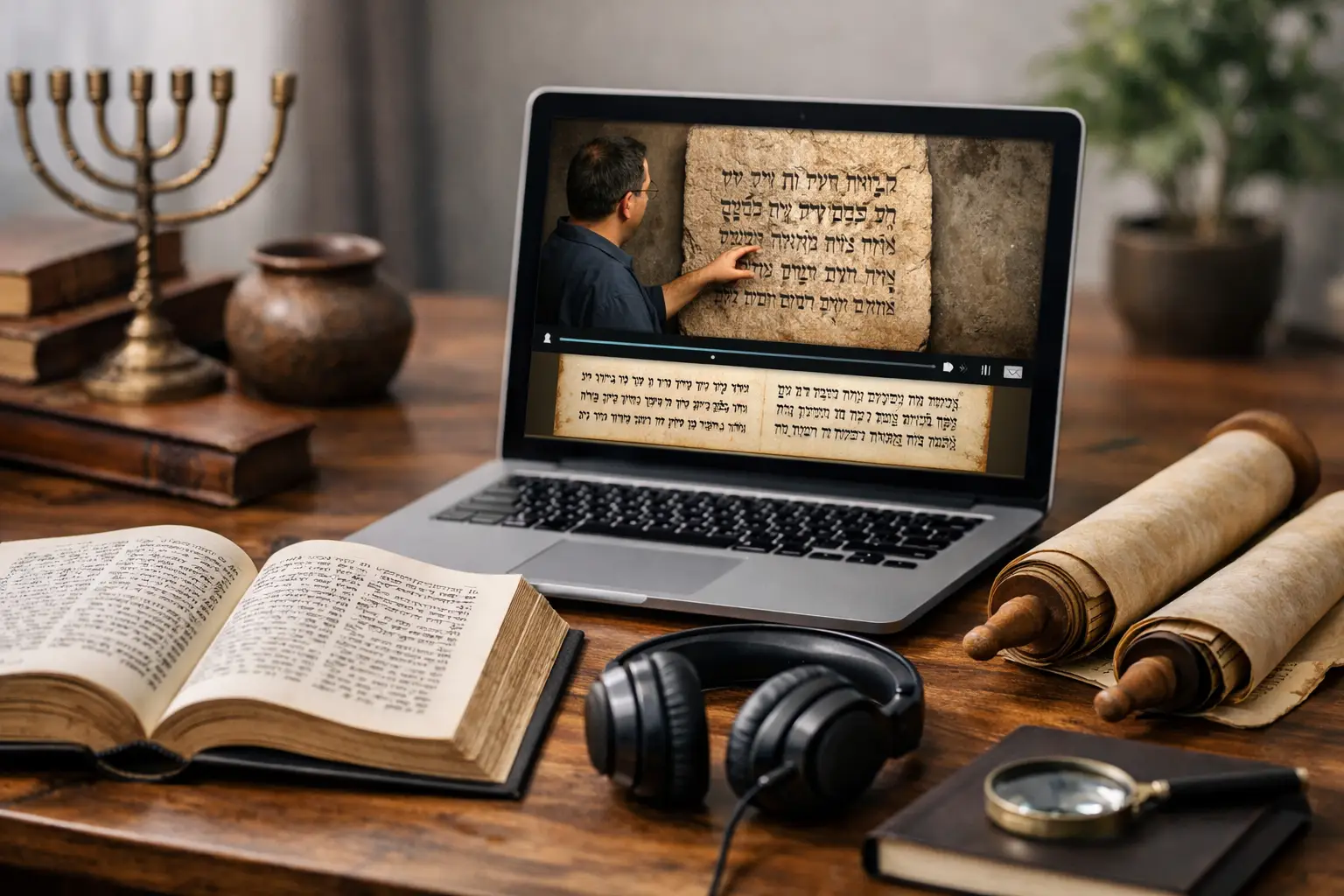
Video learning is attractive for obvious reasons. You can study at your own pace, revisit difficult lessons, and build consistency without commuting. For pastors, graduate students, parents, and busy adult learners, that flexibility is often what makes Hebrew study possible in the first place.
Still, convenience alone is not a standard of quality. A polished platform with attractive slides can hide weak pedagogy. The better question is whether the video format has been used thoughtfully. Does each lesson build logically on the last? Are difficult concepts explained from more than one angle? Are students shown how to move from explanation to actual reading?
Pacing matters a great deal here. Many beginners are discouraged not because Hebrew is beyond them, but because the material is delivered too quickly and too abstractly. A good teacher knows when to slow down, when to repeat a pattern, and when to bring in a memorable example from a biblical passage. Clarity is not the enemy of rigor. In language teaching, clarity is one of the highest forms of rigor.
Look for a method that helps you remember
One of the hidden differences between courses is memory design. Some instructors assume that if information is explained once, it has been taught. Students know better. Hebrew asks you to retain a new alphabet, unfamiliar sounds, dense morphology, and many small distinctions that can easily blur together.
That is why the teaching method matters as much as the content itself. A worthwhile course uses repetition without monotony, examples without overload, and memory techniques that help forms stick. It might group similar patterns together, revisit high-frequency vocabulary regularly, or teach grammar through recurring textual examples rather than disconnected drills.
This is especially important for adult learners who may not have studied a language in years. They do not need to be treated like remedial students. They need instruction designed with respect for how adults actually learn: through meaningful repetition, conceptual clarity, and a steady sense of progress.
If a course makes you feel constantly buried under terminology, something is off. Technical language has its place, especially for academic and seminary settings, but good teaching turns complexity into something graspable. It does not flatten the subject. It illuminates it.
Context changes everything
A surprising number of Hebrew courses treat the language as if it exists in isolation. That is a mistake. Biblical Hebrew becomes richer and easier to remember when it is connected to geography, archaeology, literary structure, Israelite religion, and the wider ancient Near Eastern world.
When students learn a word tied to agriculture, sacrifice, kingship, or covenant, they should be invited into the world where that word had force. When they encounter a phrase in narrative versus poetry, they should be shown how genre affects meaning. When a grammatical form appears in a well-known passage, they should see how that form contributes to interpretation.
This is not decorative background information. It directly strengthens language learning. Context gives grammar a home. It also keeps motivation alive. Many students persist in Hebrew not because parsing is thrilling on its own, but because every small gain opens a larger vista into text, history, and theology.
That is one reason many learners are drawn to teachers who bring an interdisciplinary lens to the classroom. A course shaped by love for the language and culture of ancient Israel tends to feel different from one built only around textbook progression. It has more life in it, and usually more staying power for the student.
Who benefits most from video study
Video courses are especially helpful for learners who value flexibility and are willing to study consistently. Independent adult learners often do very well when lessons are structured carefully and include enough review. Homeschool families may appreciate the ability to pause, revisit, and fit Hebrew into an already full educational week. Clergy and ministry leaders often prefer video because it allows serious study without requiring a fixed classroom schedule.
But there are trade-offs. If you know that you need external accountability, live feedback, or frequent correction of pronunciation and translation habits, video alone may not be enough. Many students do best with a blended model: video lessons for core content, combined with live sessions, group classes, or occasional one-on-one instruction. That combination preserves flexibility while adding the human guidance that keeps confusion from hardening into habit.
This is where an experienced teacher makes a real difference. Biblical Hebrew Teacher, for example, approaches Hebrew not as a stack of grammar units but as an exciting journey into text, culture, and memory-rich learning. For many students, that teacher-led depth is what turns a course from useful content into meaningful formation.
Signs of a course worth your time
You can usually tell within a short time whether a course has been built with care. The teacher should sound like someone who loves the subject and has spent years helping real students through common obstacles. Explanations should feel precise but welcoming. Examples should come from meaningful texts, not only invented exercises. The course should leave you with the sense that Hebrew is difficult in the right ways – stretching, not defeating.
It also helps when a course respects different goals. A seminary student preparing for exegesis may need more technical precision than a lay reader beginning to explore Genesis or Psalms. A strong course acknowledges those differences and still gives both learners a path forward. Not every student needs the same depth in the same order.
Above all, choose a course that makes you want to return to the text. The right one will not merely help you finish lessons. It will train your eyes to notice, your ears to hear, and your mind to ask better questions of the Hebrew Bible. That kind of study has lasting value because it joins discipline with delight.
If you are going to spend your time learning Biblical Hebrew, choose a course that honors the language enough to teach it fully – as grammar, literature, history, and inheritance all at once. When that happens, even a video lesson can feel like the beginning of a real encounter.