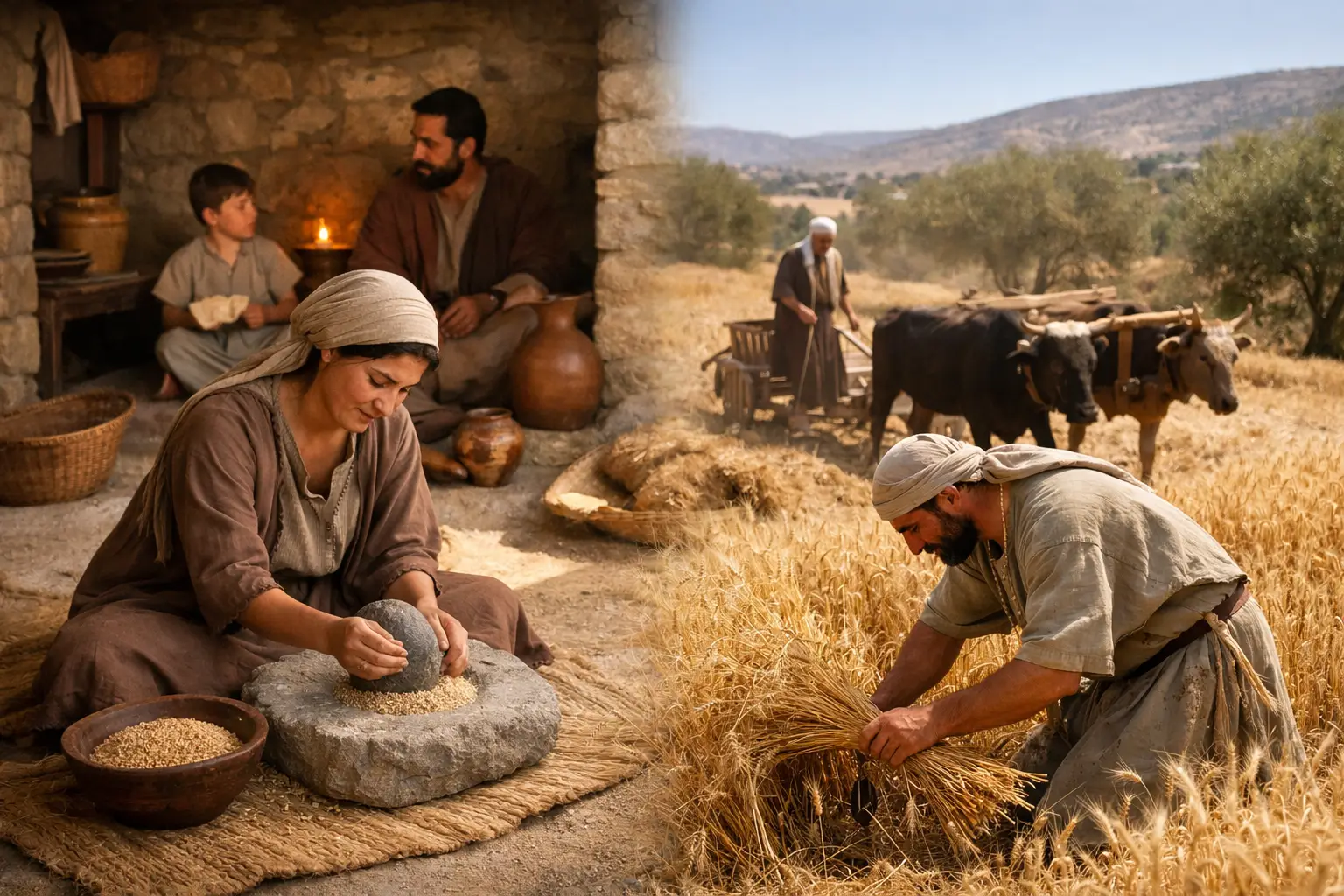
A clay oven still warm from baking, a child sent to fetch water, seed pressed into stony soil before the rains – ancient Israel daily life was built from such ordinary, demanding moments. The Bible preserves prayers, laws, royal intrigues, and prophetic visions, but these texts arose among families who milled grain, tended animals, repaired walls, welcomed guests, and marked the passing seasons. When we attend to that setting, familiar passages gain color, pressure, and human warmth.
For students of Biblical Hebrew, this is one of the great joys of the language. Hebrew words are not merely vocabulary items to memorize for a translation exercise. They carry the sounds, materials, landscapes, and relationships of a living world. Learning them can become an exciting journey into the culture of ancient Israel and the foundational book that has shaped so much of Western civilization.
Ancient Israel Daily Life Began at Home
Most Israelites lived in small agricultural settlements or in the crowded neighborhoods of towns such as Jerusalem, Lachish, or Samaria. Their homes were generally built of local stone and mudbrick, often arranged around a central courtyard. Archaeologists commonly call one widespread layout the four-room house, though not every household fit this pattern and not every region used the same design.
The home was a place of work as much as rest. A courtyard could hold storage jars, food preparation areas, animals during part of the year, and the tools of household labor. Upper spaces or roofs might be used for drying produce, sleeping in warm weather, or private activity. A roof in the biblical world was not merely a roof. It was usable domestic space, which helps explain scenes involving Rahab, David, Peter, and the instruction to build a parapet around a new house.
Homes also reveal an essential truth: ancient Israel was not socially uniform. A farming family in a hill-country village did not live like an elite household connected to the royal court. Urban residents had different access to markets, imported goods, and political institutions. Wealthier homes might contain finer pottery, more storage capacity, or decorative objects, while poorer families faced a more precarious existence. Scripture speaks to both worlds, sometimes in the same chapter.
The household was an economic unit
The Hebrew word bayit can mean “house,” but it often means more than a building. It can refer to a household, a family line, or a dynasty. Context determines the meaning. That flexibility reflects a reality of ancient life: kinship, labor, inheritance, and identity were closely intertwined.
Men, women, children, servants, resident foreigners, and enslaved people could all belong to a household, though their power and security differed greatly. We should resist romanticizing this setting. Biblical laws concerning debt, widowhood, slavery, and gleaning exist because vulnerability and exploitation were real. Yet those laws also show a people wrestling with how worship of Israel’s God should shape the treatment of neighbors and dependents.
Bread, Water, and the Rhythm of the Seasons
Bread was the daily staple. Grain, especially barley and wheat, had to be planted, harvested, threshed, winnowed, ground, mixed, and baked. This long chain of labor gives force to the simple request, “Give us this day our daily bread.” Bread was not a convenience. It represented provision, effort, and survival.
A typical diet included bread, legumes, olives and olive oil, grapes and wine, figs, dates, onions, garlic, and seasonal fruit. Meat was eaten, but for many ordinary households it was more likely to appear at feasts, sacrifices, or special occasions than at every meal. Milk products may also have been part of the diet, depending on a family’s animals and local practices.
Water required effort. Springs, wells, cisterns, and rainfall were precious, especially in the hill country. The land’s agricultural calendar depended on the early and latter rains. A delayed rain could mean anxiety; drought could bring hunger, debt, migration, and social upheaval. When biblical poetry calls God the giver of rain or describes the land as drinking water from heaven, it speaks into the daily experience of people whose fields could not be taken for granted.
The Hebrew word lechem, usually translated “bread,” can at times mean food more broadly. That is worth noticing. In a world where bread stood at the center of the table, the word could naturally expand to represent nourishment itself.
Work in Field, Workshop, and Marketplace
Agriculture shaped the year, but ancient Israel was never made up only of farmers. Shepherds moved sheep and goats through the landscape. Potters formed vessels for cooking and storage. Weavers turned wool and flax into cloth. Carpenters, metalworkers, scribes, merchants, and builders supplied the needs of villages and cities.
The Hebrew Bible often assumes this world without pausing to explain it. A prophet can speak of a potter and clay because listeners knew the workshop. A psalm can mention sheep because shepherding was visible across the countryside. Proverbs can draw moral lessons from ants, fields, gates, scales, and vineyards because these belonged to ordinary experience.
Trade connected Israel with its neighbors. Coastal routes and inland roads carried goods, armies, ideas, and people. Imported ceramics and luxury items found in archaeological contexts remind us that even small kingdoms participated in broader networks. Still, international trade did not erase local dependence. A failed harvest in one’s own district mattered more immediately than distant commerce.
Worship Was Woven into Ordinary Time
For ancient Israelites, worship was not confined to a private interior belief. It involved time, place, food, family, sacrifice, pilgrimage, music, and ethical responsibility. The Sabbath interrupted the work week. Festivals such as Passover, Shavuot, and Sukkot connected communal worship with agricultural rhythms and Israel’s remembered story.
The Jerusalem Temple held a unique place in the religious imagination and practice of Judah, particularly after centralization reforms described in the biblical texts. Yet local shrines and varied religious practices also existed, as both archaeology and the Bible make clear. The prophets repeatedly challenge worship that is energetic but unjust, offering a searching question that remains powerful: What does devotion mean if the poor are crushed at the city gate?
This is why Hebrew terms often need cultural context. Avodah can mean work, service, or worship. The overlap is revealing. Serving God was not imagined as disconnected from the labor of hands or from responsibility toward other people. Language preserves the connections that a modern reader may miss.
Meals and hospitality carried moral weight
To eat with someone was more than consuming calories. Shared meals created bonds, marked covenant, expressed celebration, and could expose betrayal. Hospitality mattered in a landscape where travel could be dangerous and food supplies limited. Abraham’s welcome of strangers, the widow of Zarephath’s costly meal, and the many table scenes of Scripture become more vivid when read against this social reality.
At the same time, hospitality had limits shaped by class, gender, danger, and communal boundaries. Ancient Israel was a real society, not a timeless ideal. Its stories preserve generosity and cruelty, courage and fear, faithfulness and failure. That honesty is part of what makes the Bible’s social world so compelling to study.
Reading the Bible with Daily Life in View
The most fruitful way to study ancient Israel is to let text, language, and material evidence illuminate one another. Archaeology can show a grinding stone, a storage jar, an inscription, or the remains of a city gate. Biblical Hebrew can show how an author names bread, field, household, servant, covenant, or rest. The biblical text can reveal how those things were interpreted within Israel’s memories, struggles, and hopes.
None of these sources answers every question. Archaeological evidence is incomplete, dates and interpretations are debated, and the Bible is not a modern documentary record of every household. Careful study welcomes those limits. It also recognizes that the broad picture is remarkably rich: people lived close to the land, depended on extended households, navigated political uncertainty, and encountered God in the pressing concerns of work and worship.
For the learner, even a small Hebrew discovery can open a door. Notice how a word is repeated in a narrative. Ask what an object or task would have meant to the first hearers. Picture the courtyard, the grain field, the city gate, or the journey to Jerusalem before rushing to a modern application. The language of ancient Israel then becomes more than a code to decipher. It becomes an invitation to listen more carefully to the people, places, and sacred texts that continue to speak across the centuries.