
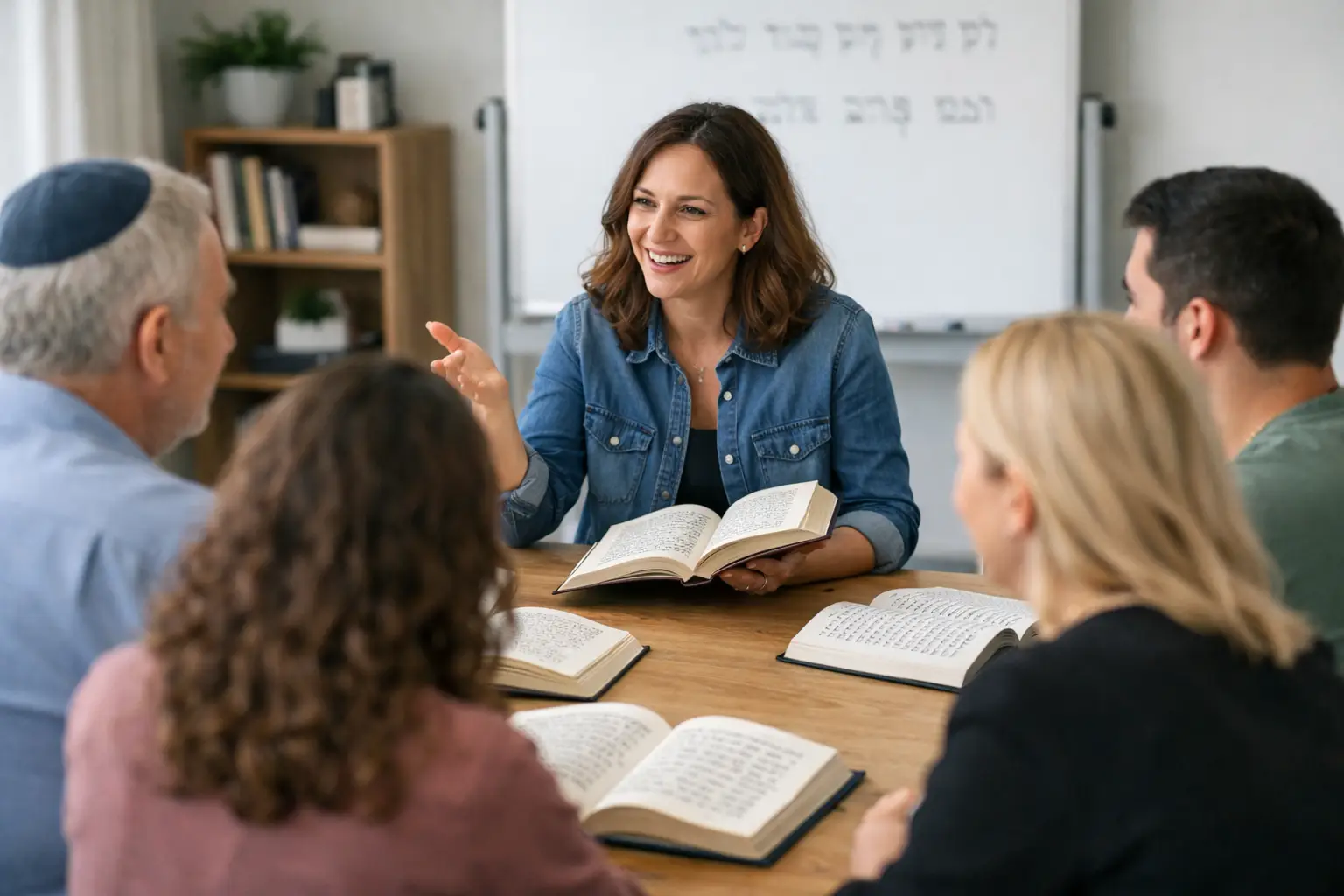
A single Hebrew word can change the way a familiar passage is heard. When learners encounter hesed, ruach, or shalom in the original language, they soon discover that a dictionary definition is only the beginning. Small group Hebrew classes create the setting where those discoveries can be explored carefully, asked about freely, and remembered long after the lesson ends.
For students drawn to the Tanach, the Hebrew Bible, ancient Israel, or the intellectual world behind Scripture, the question is not simply whether to study Hebrew. It is how to study it in a way that remains joyful, serious, and sustainable. A small live class offers an uncommon balance: enough personal attention to build confidence, enough fellow learners to make the journey lively, and enough structure to move from the aleph-bet toward real reading.
Why Small Group Hebrew Classes Work
Biblical Hebrew is not learned by collecting grammar charts alone. Verb forms, prefixes, suffixes, vocabulary, and sentence patterns must become familiar enough that a reader can recognize them in a text without starting over each time. That requires repetition, but it also requires meaning.
In a small class, a teacher can see where understanding has taken hold and where it has not. Perhaps one student can identify a noun but hesitates over its ending. Another remembers the vocabulary but loses the thread when a verb appears with a prefixed conjunction. These are ordinary stages of learning, and they are much easier to address in a conversation than through a recorded lecture alone.
The group itself becomes part of the learning process. Hearing another student ask a question often clarifies an issue you did not yet know how to name. Reading a line aloud together makes the sounds and rhythm of Hebrew more memorable. Celebrating a difficult verse that finally begins to make sense gives the work a sense of shared accomplishment.
This does not mean a group class is automatically better than every alternative. A student with a highly irregular schedule or a very specialized research goal may need individual instruction. Recorded courses can also be excellent for review and for learners who need to proceed at an unusual pace. But for many beginning and intermediate students, a small group offers the most fruitful middle ground.
The Difference Between a Class and a Community of Readers
A large course can deliver information efficiently. A small class can cultivate readers. The distinction matters because Biblical Hebrew opens onto a world rather than a set of isolated exercises.
When a passage is read closely, grammar naturally leads into larger questions. Why does this verb form create urgency in a narrative? What does a word for shepherd, gate, covenant, wilderness, or house suggest about daily life in ancient Israel? How does a repeated phrase shape the movement of a psalm? These questions connect language to geography, archaeology, history, literary artistry, and the cultural inheritance of the Jewish people.
A good teacher does not use context as decoration around grammar. Context helps grammar become intelligible. When students understand how a root works across related words, or why a biblical image would have been vivid to an ancient audience, vocabulary gains a home in memory. Hebrew begins to feel less like a code and more like the language of a living textual world.
That wider perspective is especially meaningful for clergy, religious educators, theology students, and serious independent learners. It equips them to approach familiar translations with greater care. Rather than treating Hebrew knowledge as a way to make dramatic claims about a verse, they learn to notice nuance, ask better questions, and respect the complexity of the text.
What a Strong Small Group Class Should Include
The best classes make room for both discipline and delight. Students should expect to learn the building blocks of the language: the Hebrew alphabet, pronunciation, vocabulary, noun patterns, verbal roots, and the basic structure of biblical sentences. Yet the experience should never feel like an endless march through disconnected rules.
Live instruction is especially valuable at the beginning. Pronunciation can be modeled and corrected gently. A teacher can explain why a particular form matters before students become discouraged by its appearance. Questions can be answered in the moment, when the learner is most ready to understand.
Memory techniques also matter more than many students expect. Biblical Hebrew contains patterns, and a skilled teacher helps learners see them. Instead of treating every word as a separate burden, students can connect vocabulary by root, notice recurring endings, and use sound, visual association, and repeated reading to strengthen recall. Decades of teaching experience often show up in these practical details: the explanation that makes a form suddenly recognizable, the exercise that turns confusion into familiarity, or the review method that keeps earlier lessons alive.
A well-designed class should include regular opportunities to read real biblical Hebrew, even at an early stage. The texts may be short and carefully selected, but they remind students why they began. Each phrase read in the original is a step toward a more direct encounter with one of the foundational literary collections of ancient Israel and the Western world.
The Right Pace Is a Serious Decision
Many adults approach Hebrew study with enthusiasm and then overestimate how quickly they can absorb a new writing system and grammatical structure. The desire to read Scripture soon is admirable. Still, speed without retention often leads to frustration.
Small groups are helpful because they establish a humane rhythm. Weekly meetings create accountability, while time between sessions allows vocabulary and patterns to settle. Students learn that progress is not measured only by finishing chapters. It is also measured by recognizing a root in a new verse, reading more smoothly than last month, or asking a more precise question about a text.
The ideal pace depends on a learner’s starting point and purpose. A seminary student preparing for an exam may need focused, accelerated work. A homeschool family may prefer a gentler course with room for conversation. A busy pastor may need a manageable weekly commitment that restores rather than exhausts intellectual energy. The right class respects these realities without lowering the seriousness of the subject.
How to Prepare for Your First Class
You do not need prior language training to begin Biblical Hebrew. Curiosity, consistency, and a willingness to sound out unfamiliar letters are more useful than perfectionism. Still, a few habits make the first weeks far more rewarding.
Set aside brief study periods during the week rather than relying on one long session. Ten or fifteen focused minutes spent reviewing letters, vocabulary, or a recent reading can be remarkably effective. Read aloud when possible. Biblical Hebrew was heard as well as seen, and the physical act of speaking helps many learners retain forms and words.
Bring questions to class, including basic ones. Confusion is not evidence that you lack an aptitude for languages. It is evidence that you are paying attention. In a small group, questions become a gift to the whole class because they reveal the places where careful explanation is needed.
It also helps to begin with a realistic goal. You may hope to read a favorite psalm with greater understanding, follow a Torah portion more closely, teach with added depth, or enter the linguistic world of ancient Israel for its own sake. A clear goal will sustain you when the alphabet feels strange or a verb pattern seems stubborn.
What You Gain Beyond Grammar
The lasting gift of Hebrew study is not merely the ability to parse a verb, though accurate parsing has its place. It is the gradual formation of a different kind of attention. Students learn to slow down before a text. They notice repetition, wordplay, ambiguity, and literary structure. They become more alert to what translation can convey beautifully and what it must sometimes simplify.
That attention can enrich personal study, teaching, preaching, family learning, and scholarly work. It can also create a deeper affection for the language and culture of ancient Israel. Hebrew study invites learners into a long conversation with scribes, poets, prophets, translators, commentators, and communities who have treasured these texts across centuries.
A small class makes that conversation feel possible. Week by week, letters become words, words become phrases, and phrases begin to carry the force of a living text. The first time you recognize a familiar word in a verse without being told, you may find that Hebrew has already begun to change the way you read.