A Bar Mitzvah can pass quickly: the family gathers, the Torah is read, a young man speaks before his community, and a remarkable day becomes a treasured memory. Hebrew for bar mitzvah study gives that day deeper roots. Rather than treating Hebrew as a short-term hurdle to clear before the service, it can become a first encounter with the language of Torah, the prayers of Jewish life, and the world of ancient Israel.
That does not mean every student must become a Hebrew grammarian before the celebration. It means giving the words he will recite enough attention, context, and joy that they become his words. A few carefully learned letters, roots, blessings, and Torah phrases can change the experience from memorizing sounds into standing within a living tradition.
Begin With the Hebrew He Will Actually Use
Bar Mitzvah preparation is most effective when it has a clear center. The first Hebrew a student studies should usually be the Hebrew he will encounter on the day itself: his Torah portion, Haftarah, blessings, and any prayers or remarks he will lead. This creates immediate purpose. Every new sound, letter, and word belongs to a real moment that is approaching.
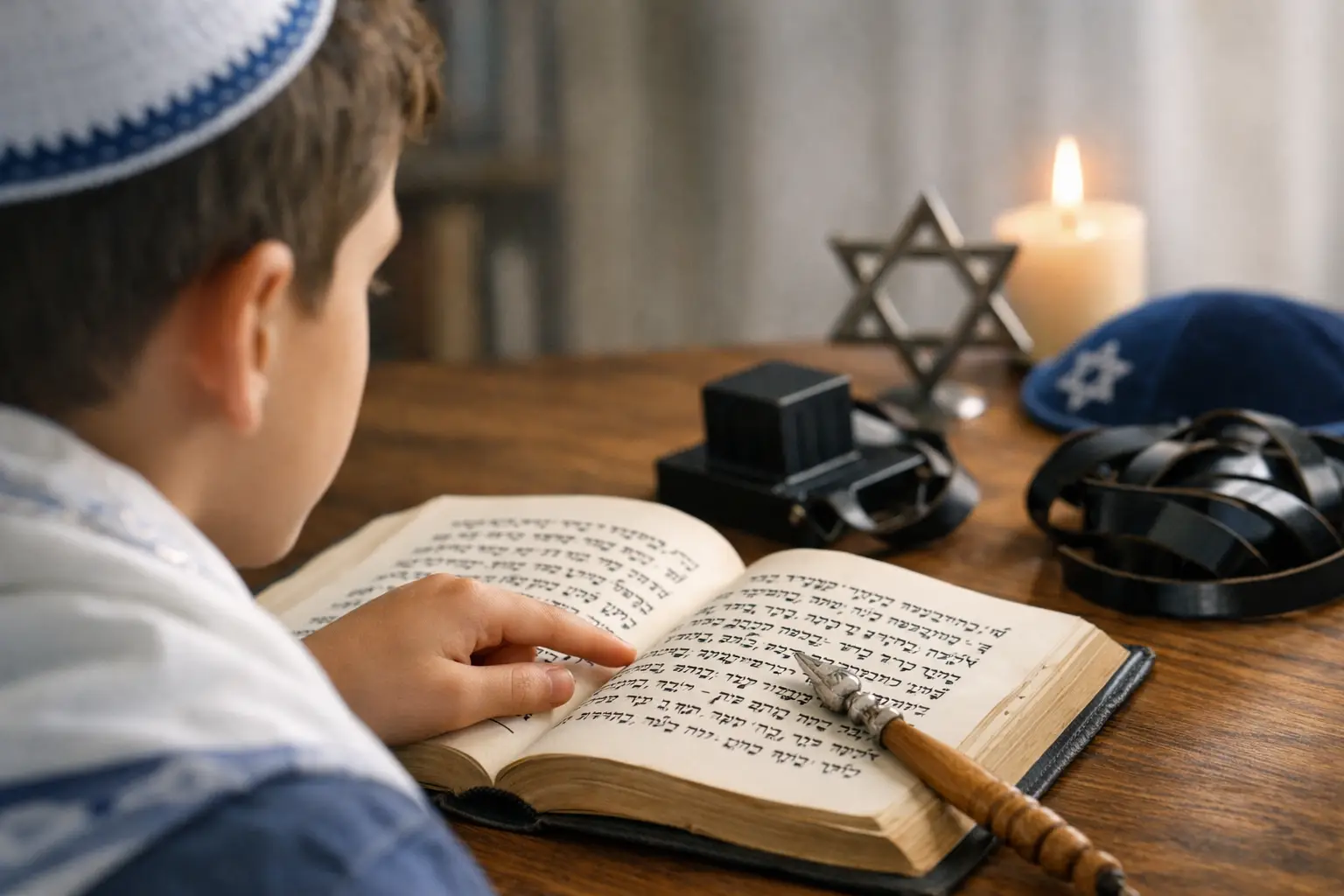
Start by helping the student hear the difference between Hebrew as a written language and Hebrew as a spoken, chanted tradition. Hebrew moves from right to left. Its consonants form the visible structure of the word, while vowel signs guide pronunciation. The Torah scroll itself is written without those vowel signs, so learning to chant from a printed, pointed text also opens a window into how Jewish communities preserve reading traditions.
A student does not need to decode an entire Torah scroll independently to appreciate this. Even recognizing why the printed text looks different from the scroll can be exciting. It reveals that the marks on the page are not decorative extras. They are part of a careful chain of learning, listening, and remembering.
Learn Meaning Alongside Sound
Accurate chanting matters. So does meaning. When a student learns only the sounds of a passage, he may perform it beautifully while feeling detached from what he has said. When he learns only an English translation, he misses the texture and force of the Hebrew itself. The richest preparation brings the two together.
Take the opening blessing before reading Torah: Bar’chu et Adonai ham’vorach, often translated, “Bless the Lord who is blessed.” A teacher can guide a student through its rhythm and pronunciation, but also pause over the central idea of blessing. The congregation’s response is not merely a cue in the service. It is a communal act. The young reader calls the community to bless, and the community answers.
The same approach works especially well with names and repeated words in the Torah portion. If a passage includes Mitzrayim (Egypt), eretz (land), brit (covenant), shalom (peace), or ben (son), those words can become anchors. They are not isolated vocabulary items. They carry history, imagery, and theological weight.
A helpful question is: What does this Hebrew word allow us to notice that a translation alone may not show? Sometimes the answer is a repeated sound. Sometimes it is a wordplay or a verbal pattern. Sometimes it is simply the realization that the language of a familiar English Bible passage has its own ancient shape and music.
Hebrew for Bar Mitzvah Study Should Be Personal
A Bar Mitzvah is not a standardized academic exam. Students arrive with different backgrounds, learning styles, schedules, and levels of confidence. One may already read Hebrew fluently from day school or synagogue education. Another may be meeting the aleph-bet for the first time. One may love historical questions; another may respond most strongly to the melodies and communal experience.
For this reason, the best program is neither rushed nor overloaded. A beginner might focus on reading confidence, essential blessings, a handful of meaningful words from the portion, and a clear understanding of what happens during the service. A student with more experience may explore Hebrew roots, grammar, literary patterns, or the historical setting of the parashah.
The goal is not to force every learner through the same syllabus. It is to give each student a genuine accomplishment. He should finish his preparation able to say, with honesty, “I know something of the language I have read, and I know why these words matter.”
Build Confidence Through Small, Visible Gains
Hebrew can feel intimidating at first because it looks unfamiliar to English readers. The answer is not to hurry past the basics. It is to make the basics memorable. Learning the aleph-bet in small groups, connecting letters to sounds, and returning often to familiar words creates confidence quickly.
Memory techniques are especially valuable here. A letter is easier to retain when it has a distinctive visual association, a sound pattern, and a word the student recognizes. A vocabulary word lasts longer when it appears in a prayer, a Torah verse, and a conversation about its meaning. Repetition is necessary, but repetition with context is far more powerful than repetition alone.
Short, regular practice sessions usually serve a student better than occasional marathon study sessions. Ten focused minutes of reading, chanting, and reviewing can establish rhythm. Families can support this without becoming Hebrew instructors themselves. Ask the student to teach you one word he learned, listen to a line of the portion, or invite him to explain what a blessing means. Teaching others helps knowledge settle into memory.
Let the Torah Portion Open a Larger World
The Hebrew Bible is the foundational book of ancient Israel and one of the central texts of the Western world. A Bar Mitzvah portion is therefore an invitation into a vast landscape: kings and prophets, wilderness journeys and covenant ceremonies, agriculture and family life, poetry and law.
Context gives a young reader a place to stand. If his portion concerns the wilderness, study a map and consider the challenges of travel in the ancient Near East. If it contains laws about land, harvest, or justice, ask what daily life may have looked like in an agrarian society. If it features a major biblical figure, examine the Hebrew name and the meaning it may carry.
Archaeology and comparative language study can also bring the text closer. Ancient inscriptions, seals, household objects, and neighboring languages do not replace the Torah’s message. They help students imagine the human world in which Hebrew was spoken, written, preserved, and loved. For a curious young learner, discovering that ancient Hebrew letters appear on real artifacts can make the language feel wonderfully tangible.
There is a valuable balance to preserve. Context should illuminate the Torah reading, not bury the student under information. One compelling historical detail, carefully connected to a Hebrew word or passage, will often remain in the mind longer than a full lecture.
Give Room for Questions, Not Just Correct Answers
A student preparing for his Bar Mitzvah may have serious questions about God, tradition, identity, responsibility, or the meaning of becoming a Jewish adult in his community. Hebrew study can make room for those questions because it places him close to the text itself.
He may notice that a Hebrew word has more than one possible shade of meaning. He may ask why a phrase is repeated, why a character receives a particular name, or why a Torah commandment is expressed in a particular form. These are not distractions from preparation. They are signs that study is becoming real.
A thoughtful teacher should be precise without being dismissive. Hebrew often rewards close attention, but not every observation produces a dramatic hidden meaning. Some questions have clear grammatical answers. Others invite interpretation and discussion. Learning the difference is part of intellectual maturity and part of learning to honor the text.
Make the Celebration a Beginning
The most meaningful Bar Mitzvah preparation does not end when the final blessing is recited. The student may not continue immediately into advanced Biblical Hebrew, and that is perfectly fine. But he should leave with a path forward: confidence in the letters, affection for certain words and passages, and the sense that Torah study remains open to him.
After the celebration, a family might choose one short verse to revisit, continue with prayer Hebrew, or begin learning the recurring roots that appear throughout the Tanach. Some students are ready for a regular course of Biblical Hebrew. Others simply need an occasional return to the language so their accomplishment does not fade.
The lasting gift is not flawless pronunciation or a stack of completed worksheets. It is the discovery that Hebrew is more than a requirement for one important morning. It is a doorway into the language, culture, history, and sacred texts of ancient Israel – a doorway a young man can return to throughout his life.