
If you want to understand a people, look at their table. Ask what they baked when grain was scarce, what they pressed from olives after harvest, what they served at a family feast, and what they could not afford in a lean year. When we ask what did ancient Israelites eat, we are not chasing a bit of historical trivia. We are stepping into the ordinary world behind the Hebrew Bible – the fields, kitchens, vineyards, flocks, and seasons that shaped the language of ancient Israel.
Food in ancient Israel was never just about taste. It was tied to land, rainfall, covenant, labor, purity, celebration, and memory. The Bible assumes its audience knows what threshing floors, winepresses, ovens, fig cakes, and gleaning mean. Once you begin to see the food world of the Israelites, many familiar passages become more vivid and more human.
What did ancient Israelites eat in daily life?
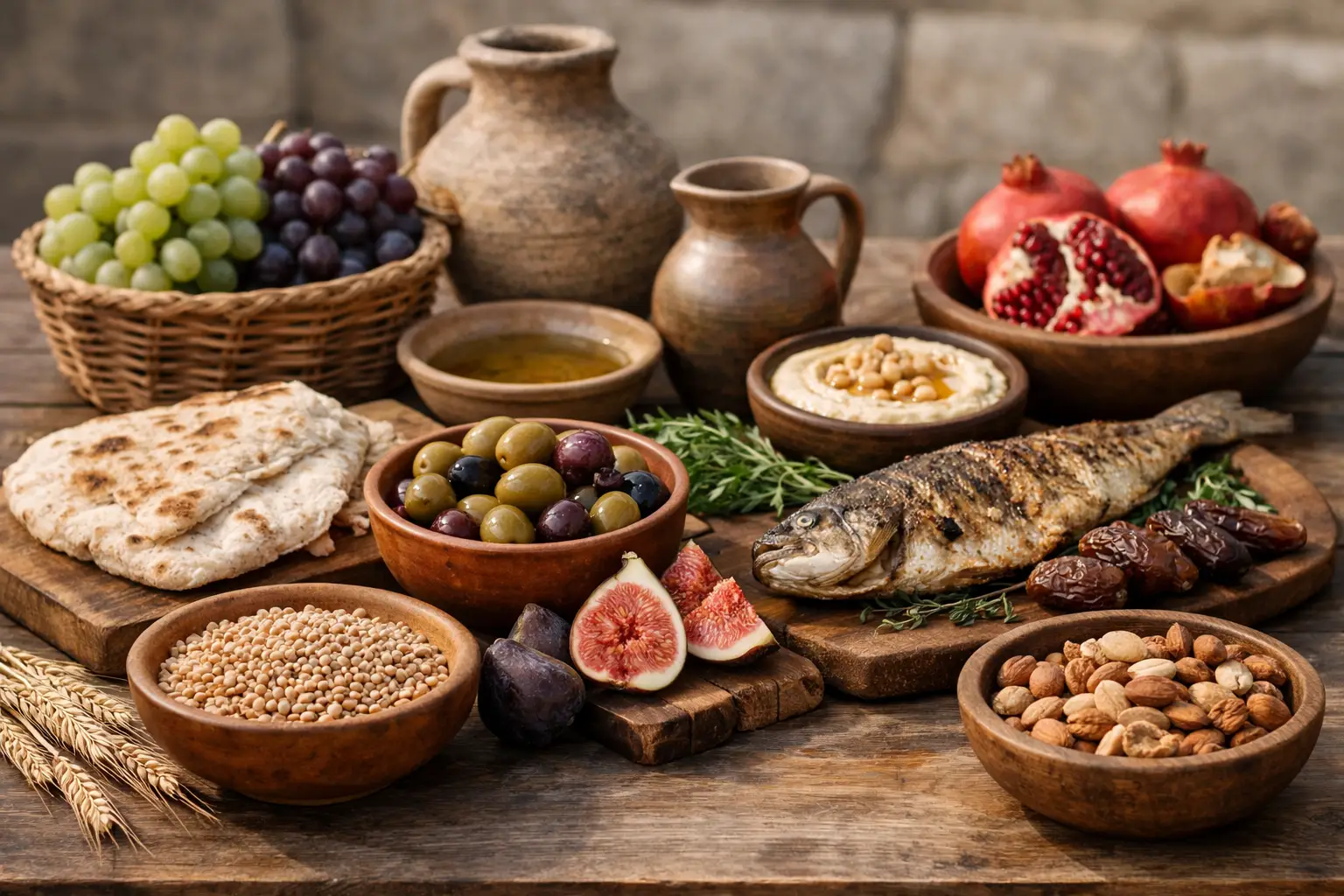
For most people, daily meals were simple. Bread stood at the center. Not bread as a side item, but bread as the staff of life. Grain, especially wheat and barley, was ground into flour and made into loaves or cakes. Barley was often associated with poorer households and with harder conditions, while wheat was generally more prized. That distinction matters when biblical texts mention barley harvests or barley loaves. Sometimes the detail is social as much as agricultural.
Alongside bread, ancient Israelites ate legumes such as lentils and beans, which provided crucial protein. A bowl of lentil stew was not exotic. It was practical, nourishing food. The story of Esau selling his birthright for stew lands differently when you remember that this was a world where hunger was immediate and meals were closely tied to physical survival.
Olives and olive oil were equally central. Oil was used for cooking, dipping, lighting, anointing, and ritual purposes. If grain gave calories, olive oil added richness and flexibility. The triad of grain, wine, and oil appears repeatedly in biblical literature because it reflects the agricultural heartbeat of the land.
People also ate fruits when in season or dried for storage. Figs, dates, grapes, and pomegranates appear often in the Bible and in the archaeology of the region. Fresh fruit was seasonal, but dried figs and raisins could travel and keep. These were valuable foods in a climate where preservation mattered. A cake of figs or a cluster of raisins was portable energy, but also a sign of settled agricultural life.
Dairy products likely played a regular role, especially in pastoral settings. Milk in the ancient world was usually processed into yogurt-like products, curds, or cheese, since fresh milk spoiled quickly. The famous biblical phrase about a land flowing with milk and honey evokes abundance, but it is not describing luxury desserts. It is speaking the language of pastoral and agricultural plenty.
The land shaped the menu
Ancient Israel was not one uniform environment. Hill country, valleys, wilderness edges, and coastal plains each offered different possibilities. Diet depended on region, class, season, and political stability. A family in the Judean hill country ate from a somewhat different rhythm than one in the Jezreel Valley.
Rainfall was a constant concern. Ancient Israel depended heavily on seasonal rains rather than on a great river system like Egypt’s Nile. That meant the food supply could be fragile. A few failed rains did not merely inconvenience farmers. They threatened grain stores, vineyard yields, and survival itself. Biblical references to drought are not background scenery. They are reminders that food security was always uncertain.
That helps explain the spiritual force of harvest language in the Tanach. Firstfruits, tithes, sabbatical patterns, and prayers for rain were woven into a society where food came from a close, vulnerable relationship with the land. Hebrew vocabulary itself preserves this world. Words for grain, vineyard, threshing, and pressing are not abstractions. They belong to lived experience.
Meat was real, but not everyday fare
Modern readers often imagine biblical meals as either lavish banquets or nonstop roasting over open fires. The truth is more modest. Meat was certainly eaten, but for many households it was not an everyday staple. Sheep and goats were economically valuable for milk, wool, and reproduction, so slaughtering an animal was a significant choice.
Meat was more likely to appear at festivals, sacrificial meals, acts of hospitality, and important family occasions. When Abraham prepares a calf for his guests, the scene signals generosity. When the father in Jesus’ parable kills the fattened calf, it signals exceptional celebration. These are not casual Tuesday dinners.
Fish may have been eaten in some areas, especially near the Jordan Valley, the Sea of Galilee, or through trade, but inland hill-country populations were less dependent on it. Game was also known, though probably not a major food source for most people. The biblical world includes hunters, shepherds, farmers, and fishermen, but their diets were not all the same.
Clean and unclean foods in Israelite life
Any serious answer to what did ancient Israelites eat must include food laws. Leviticus and Deuteronomy identify animals that may be eaten and those that may not. These laws shaped Israelite identity in a profound way. They marked boundaries at the table, where community and holiness often met.
Animals such as sheep, goats, and cattle were permitted if properly slaughtered. Pigs, despite being known in the broader ancient Near East, were forbidden to Israelites under biblical law. Certain birds were prohibited. Fish required fins and scales. Blood was not to be consumed.
Here we should be careful. Biblical law gives one picture, archaeology sometimes gives another, and actual practice may have varied by period, location, and level of religious observance. In some places and times, the ideals of the text and the habits of the population may not have lined up perfectly. That tension is part of real history. It does not weaken the biblical witness. It reminds us that ancient Israel, like any society, was complex.
Bread, wine, and the sacred calendar
Food becomes especially meaningful when we look at Israel’s festivals. Passover brings unleavened bread into focus, not as a random ritual item, but as edible memory. To eat matzah is to remember haste, deliverance, and the departure from Egypt. Bitter herbs intensify that memory.
The Feast of Weeks and the Feast of Booths were also tied to harvest cycles. These were not detached religious ceremonies. They emerged from the timing of grain, fruit, and ingathering. Worship in ancient Israel was deeply agricultural because life in ancient Israel was deeply agricultural.
Wine belonged to this world as well. Vineyards required patience and stability. Wine could gladden the heart, mark celebration, accompany offerings, and also become a symbol of excess when abused. Like many gifts in the Bible, it appears with both joy and warning.
Honey in biblical texts may sometimes refer to bee honey, but often likely refers to date syrup. That matters because it places sweetness within the ecology of the region. Dates were more than snacks. They could be processed, stored, and traded.
Archaeology fills in the texture
Texts tell us a great deal, but archaeology helps us picture the kitchen. Grinding stones, storage jars, ovens, animal bones, vineyard installations, and olive presses all provide evidence for what people produced and ate. Charred seeds and plant remains can reveal which crops were present at specific sites.
This material evidence often confirms the centrality of cereals, olives, grapes, and legumes. It also reminds us that women’s labor was fundamental to household food production. Grinding grain into flour was time-consuming and physically demanding. Bread did not appear by magic. It came through daily work that sustained the household and, in a real sense, the whole social order.
For students of Biblical Hebrew, this is where language comes alive. Words for kneading, baking, pressing, gleaning, and roasting belong to an embodied world. They are easier to remember and richer to interpret when you can imagine the sound of querns, the smell of bread ovens, and the urgency of bringing in the harvest before the rains.
So what did ancient Israelites eat, really?
They ate what the land and the season allowed: bread from wheat and barley, lentils and beans, olives and olive oil, grapes and wine, figs and dates, pomegranates, nuts, milk products, and sometimes meat. They ate within the pressures of drought, debt, class difference, war, and harvest rhythm. They ate with gratitude, anxiety, celebration, and covenantal memory.
And like all real people, they did not eat one unchanging biblical menu. A royal table differed from a farmer’s table. A feast differed from a famine. The food of settled villages differed from the food available during displacement or siege. The Bible preserves all these settings, which is one reason its food references feel so concrete.
To study the food of ancient Israel is to recover something intimate. You begin to see that the world of the Tanach was not floating in abstraction. It had kitchens, fields, jars, mills, shepherds, crumbs, hunger, abundance, and blessing. That is part of what makes Biblical Hebrew such an exciting journey. The language carries not only ideas, but the tastes and textures of a civilization.
The next time you read about daily bread, firstfruits, vineyards, or a morsel dipped in oil, pause for a moment. The table of ancient Israel is still set before the careful reader, and it has much to teach.